
In this article
- How the system works
- Why the system is needed + risks of neglect
- The maintenance regime — what, how often, and how
- Who is authorized to maintain and certify
- Standards and regulation
- Documentation and required forms
- Common faults and warning signs
- The value of professional maintenance management / How Domera helps
- Frequently asked questions
- Further reading
- Frequently asked questions
Grease Separator
A grease separator (also known as a "fat separator" or Grease Trap) is a facility installed on the wastewater line of commercial kitchens that captures the fats and oils from the wash water before they continue to the sewer network. Its role is simple but critical: to stop the grease where it is easy to remove it — in a dedicated facility — instead of it accumulating, hardening and blocking the sewer lines of the building and of the city.
Part of a bigger picture: this system is one component within a complete preventive maintenance plan. For the full framework — all the systems, frequencies, authorized parties and forms — see the complete PPM guide.
For a building manager whose building operates a kitchen — a restaurant, cafeteria, coffee shop or institutional kitchen — the grease separator is an operational, legal and environmental risk point all at once. Pumping the separator is a legal (statutory) requirement at a quarterly frequency, and requires an authorized party with a dedicated license and orderly weighing documentation. In this article we explain how the facility works, why its neglect is so costly, what the required maintenance regime is in Israel, who is authorized to pump and document, and how to manage this without falling into a blockage or an audit.
Part of a bigger picture: pumping the grease separator is one component within a complete preventive maintenance plan. For the full framework — all the systems, frequencies, authorized parties and documents — see the complete PPM guide.
How the system works
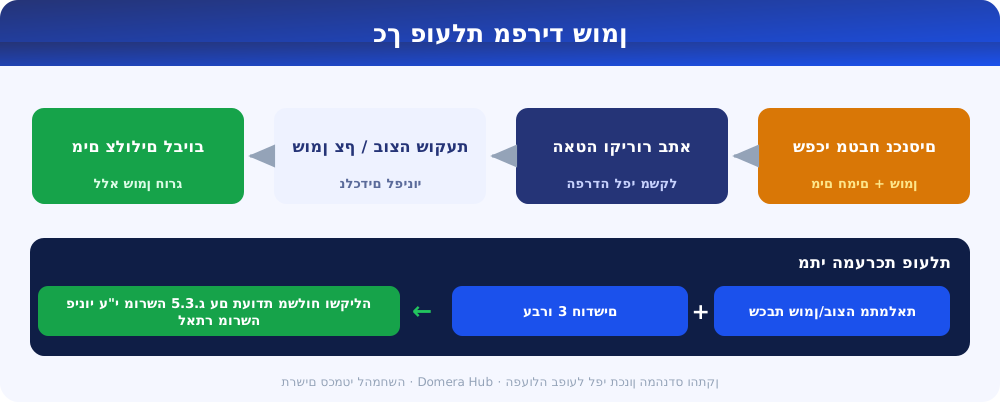
The grease separator is installed on the drainage line between the kitchen sinks, dishwashers and the hood and the sewer connection, usually as close as possible to the grease source. The operating principle is based on simple physics of phase separation by specific gravity: fats and oils are lighter than water and float; food scraps and heavy solids are heavier than water and sink.
When the hot wastewater enters the separator chamber, the flow is deliberately slowed and the water begins to cool. The slowing and cooling are the key: as long as the grease flows fast and hot it remains mixed with the water, but the moment it slows and cools it separates into a distinct layer and floats to the surface of the chamber. In parallel, food scraps and heavy solids sink to the bottom as sludge. Between the two layers a relatively clean middle water layer remains, and only it continues — through an outlet baffle/submerged partition that prevents the floating grease from exiting — to the sewer line.
Separators differ in size and location: a small separator under the sink, a larger room separator in a technical room, or an external underground facility for high-volume kitchens. Common to all is one principle — they fill up. The upper grease layer and the lower sludge layer grow with every service, and reduce the active separation volume until the separator stops functioning. Therefore the main action is not "repair" but periodic pumping of the grease and solids to an authorized reception site.
The grease separator is part of the building's water, drainage and plumbing systems, and is closely related to the kitchen hood system and the cleaning of the grease ducts: the hood captures grease from the air, the separator captures grease from the water — two complementary grease-removal tracks in the same kitchen, both of which require documented periodic maintenance.
Why the system is needed + risks of neglect
The value of the grease separator is double prevention — sewer blockages and environmental harm. Grease poured directly into the sewer cools, hardens and sticks to the pipe walls, accumulating over time into "fatbergs" that block the flow. Such a blockage does not stop at the building's boundary — it may return to the kitchen as flooding, pollute the environment, and damage the municipal sewer line to which all the surrounding buildings are connected.
The risks of neglecting the grease separator accumulate on several planes:
- Operational — a full separator stops separating: grease passes on, accumulates in the piping and causes recurring blockages, kitchen flooding and service shutdown.
- Environmental and legal — releasing excess grease to the sewer is a breach of the environmental quality requirements and of the sewage corporation, and exposes the business to fines and lawsuits.
- Odor and pests — grease and sludge that accumulate and are not pumped decompose, emit a sharp odor and attract pests.
- Indirect fire risk — the accumulation of grease in the kitchen array integrates into the general grease-fire risk; cleaning the hood and the separator are two sides of the same risk reduction.
- Liability and licensing — a commercial kitchen is a business requiring a license; pumping the grease separator and documenting it are part of the licensing requirements, and their absence may endanger the business license.
The maintenance regime — what, how often, and how
The grease separator has a clear maintenance regime focused around the pumping:
- Grease separator pumping — quarterly (every 3 months). This is a mandatory statutory action applying to every site where a separator is installed. The pumping empties the floating grease layer and the settling solids sludge, restores the separator's active separation volume, and transfers the waste to an authorized wastewater reception site.
- The documents to keep for each pumping: a delivery certificate + weighing certificate for the reception of the wastewater at an authorized site. The weighing proves how much waste was pumped and where it was transferred — this is the proof that the pumping was indeed carried out and that the waste reached a legal destination.
Note: 3 months is the minimum mandatory frequency. A kitchen with high cooking volume may fill the separator faster and require more frequent pumping — the rate of accumulation depends on the amount of grease, the size of the separator and the nature of the cooking. Beyond the formal pumping, it is recommended that the kitchen staff not pour grease and quantities of food directly into the sink, and that the maintenance manager include a visual inspection of the separator in the routine round — the thickness of the grease layer, odor and proper flow are early signs of the need for earlier pumping.
Who is authorized to maintain and certify
Pumping the grease separator and transporting the waste are carried out solely by a holder of a business license for transporting wastewater under licensing item 5.3.c — an authorized pumping contractor who holds a dedicated license for transporting wastewater and disposing of it to a certified reception site. This is not a "plumber" or a general cleaning contractor: transporting wastewater is a supervised activity that requires a specific business license.
The authorized party is the one that issues the delivery certificate and weighing certificate for each pumping — the determining documents for proving compliance. Do not approve pumping carried out by a party without a 5.3.c license or without an authorized reception site — such pumping is not considered compliance with the requirement, and may even constitute an environmental offense in itself (illegal dumping).
Standards and regulation
Pumping the grease separator is a legal (statutory) requirement applying to every site where a separator is installed, and its frequency — once per quarter (every 3 months). The requirement is anchored in the kitchen's business licensing and in the requirements of environmental quality and the local sewage corporation, responsible for the integrity of the public sewer network and the quality of the wastewater flowing into it.
It is important to be precise: in our requirements matrix the pumping is defined as quarterly, statutory, by a holder of a license for transporting wastewater under licensing item 5.3.c, with a delivery certificate and weighing certificate as the mandatory documents — but it contains no specific SI number directed at the separator. Therefore we do not cite a particular standard number here, and refer generally to the standard, the terms of the business license and the current guidelines of the Authority and the sewage corporation. The size, type of separator and the exact pumping conditions will be determined by the licensing authority and the sewage corporation according to the nature of the kitchen.
Documentation and required forms
The documents that hold up the grease separator's compliance are the delivery certificate and the weighing certificate — the output of each pumping, issued by the authorized pumping contractor and attesting to the amount of waste pumped and to the authorized site that received it. Manage them as a live document chain: a certificate for each quarterly pumping, so that there is always evidence that the sequence of pumpings was maintained.
A grease separator has no dedicated fire form (unlike the fire suppression system in the kitchen hood, which has a uniform form of the National Fire and Rescue Authority — see the fire suppression systems maintenance article). The mandatory documentation for the separator is the delivery and weighing certificates. From the point of view of a licensing inspector, an environmental inspector or a sewage corporation — the series of valid certificates is the proof that the separator is pumped as required.
Common faults and warning signs
- Sharp odor from the sinks or the separator — a clear sign that the separator is too full and that the grease and sludge are beginning to decompose; requires immediate pumping.
- Slow drainage or recurring blockages in the kitchen — a grease layer that overflowed from the separator blocks the piping downstream of it; treating the symptom without pumping the separator will not solve the root cause.
- Thick grease layer on visual inspection — when the thickness of the floating grease reaches a significant portion of the chamber height, the separation capacity drops and it must be pumped earlier than the quarterly date.
- "Missing certificate or pumping without weighing" — the common documentation fault: pumping was carried out but there is no delivery/weighing certificate, or the waste was pumped to an unauthorized site — legally, this is non-compliance, and even a suspicion of illegal dumping.
- Damaged or missing baffle/submerged partition — without the internal barrier, floating grease escapes directly to the sewer even when the separator is not full.
- Blocked access to the separator — a separator buried under equipment or without an accessible service opening cannot be pumped or inspected in time.
- Direct pouring of grease into the sink by the staff — an operational habit that overloads the separator and shortens the pumping cycle; requires a procedure and training.
The value of professional maintenance management / How Domera helps
The grease separator is a classic example of a component that falls between the cracks: it has no prominent "annual certificate" but rather a series of quarterly pumpings, each with its own pair of documents — and every forgotten pumping brings the kitchen closer to a blockage, an odor and a licensing audit. Domera's Knowledge Center is designed to help the building manager see these components before they turn into a problem.
In practice, in the Domera system the grease separator pumping is managed through a preventive maintenance plan (PPM): for the pumping one open instance is opened at any given time, and closing it requires attaching the confirming delivery certificate and weighing certificate. The system sends a reminder before the next pumping date — so that the quarterly cycle is maintained and not deferred until a blockage — and produces compliance reports that show exactly that the sequence of pumpings and the documentation are complete. The idea is simple: don't rely on memory, but on a system that closes the loop against the document.
Frequently asked questions
What is a grease separator and why is it important?
A grease separator is a facility on the wastewater line of a commercial kitchen that captures fats and oils from the wash water before they reach the sewer. It is important because without it the grease cools and hardens in the piping, creates sewer blockages and flooding, and constitutes an environmental breach against the sewage corporation.
How often must a grease separator be pumped?
Pumping a grease separator is a quarterly legal requirement — once every 3 months — and applies to every site where a separator is installed. This is the minimum mandatory frequency; a busy kitchen may require more frequent pumping. For each pumping a delivery certificate and weighing certificate must be kept.
Who is authorized to pump a grease separator?
Only a holder of a business license for transporting wastewater under licensing item 5.3.c — an authorized pumping contractor who transfers the waste to a certified reception site. A plumber or a general cleaning contractor without this license is not permitted to pump and document the separator.
How does a grease separator work?
The separator slows and cools the wastewater so that the light grease floats to the surface of the chamber, the heavy food scraps sink to the bottom, and only the clean middle water layer continues — through a submerged partition that blocks the floating grease — to the sewer. The grease and sludge accumulate and therefore require periodic pumping.
What happens if the grease separator is not pumped?
A full separator stops separating: grease passes to the sewer, hardens in the piping and causes recurring blockages and kitchen flooding, emits an odor and attracts pests, and constitutes an environmental breach that may entail fines and endanger the business license.
What are the delivery certificate and the weighing certificate and why are they important?
These are the documents that the authorized pumping contractor issues for each pumping: the delivery certificate attests that the waste was transferred, and the weighing certificate attests how much was pumped and to which authorized site. Together they are the proof that the pumping was carried out lawfully and that the waste reached a legal destination.
What is the relationship between the grease separator and cleaning the kitchen hood?
Both are complementary grease-removal tracks in the same kitchen: the hood captures grease from the air and its ducts require periodic cleaning, and the grease separator captures grease from the water and requires quarterly pumping. Neglecting either of them increases the blockage risk and the grease-fire risk.
How does Domera help manage the grease separator pumping?
Through a preventive maintenance plan (PPM): one open instance per pumping, closing against the delivery certificate and weighing certificate, a reminder before the next quarterly pumping date to maintain the sequence, and compliance reports that show that the series of pumpings and the documentation are complete.
Further reading
- The PPM guide — how to build a complete preventive maintenance plan for a building, covering all the systems, frequencies and documents.
- Water and plumbing systems maintenance — the broad picture of the water supply, piping, drainage and pumps in the building.
- Fire suppression systems maintenance — the fire suppression system in the kitchen and the building that complements the grease-fire risk reduction.
- Backflow prevention, Legionella and fire reservoir — maintenance of the water systems and the contamination risks that the separator is part of the envelope preventing.
- Knowledge Center — all the guides on building systems in one place.
Frequently asked questions
What is a grease separator and why is it important?
A grease separator is a facility on the wastewater line of a commercial kitchen that captures fats and oils from the wash water before they reach the sewer. It is important because without it the grease cools and hardens in the piping, creates sewer blockages and flooding, and constitutes an environmental breach against the sewage corporation.
How often must a grease separator be pumped?
Pumping a grease separator is a quarterly legal requirement — once every 3 months — and applies to every site where a separator is installed. This is the minimum mandatory frequency; a busy kitchen may require more frequent pumping. For each pumping a delivery certificate and weighing certificate must be kept.
Who is authorized to pump a grease separator?
Only a holder of a business license for transporting wastewater under licensing item 5.3.c — an authorized pumping contractor who transfers the waste to a certified reception site. A plumber or a general cleaning contractor without this license is not permitted to pump and document the separator.
How does a grease separator work?
The separator slows and cools the wastewater so that the light grease floats to the surface of the chamber, the heavy food scraps sink to the bottom, and only the clean middle water layer continues — through a submerged partition that blocks the floating grease — to the sewer. The grease and sludge accumulate and therefore require periodic pumping.
What happens if the grease separator is not pumped?
A full separator stops separating: grease passes to the sewer, hardens in the piping and causes recurring blockages and kitchen flooding, emits an odor and attracts pests, and constitutes an environmental breach that may entail fines and endanger the business license.
What are the delivery certificate and the weighing certificate and why are they important?
These are the documents that the authorized pumping contractor issues for each pumping: the delivery certificate attests that the waste was transferred, and the weighing certificate attests how much was pumped and to which authorized site. Together they are the proof that the pumping was carried out lawfully and that the waste reached a legal destination.
What is the relationship between the grease separator and cleaning the kitchen hood?
Both are complementary grease-removal tracks in the same kitchen: the hood captures grease from the air and its ducts require periodic cleaning, and the grease separator captures grease from the water and requires quarterly pumping. Neglecting either of them increases the blockage risk and the grease-fire risk.
How does Domera help manage the grease separator pumping?
Through a preventive maintenance plan (PPM): one open instance per pumping, closing against the delivery certificate and weighing certificate, a reminder before the next quarterly pumping date to maintain the sequence, and compliance reports that show that the series of pumpings and the documentation are complete.