
In this article
- How the System Works
- Why the System Is Needed + Risks of Neglect
- The Maintenance Regime — What, How Often, and How
- Who Is Authorized to Maintain and Certify
- Standards and Regulation
- Required Documentation and Forms
- Common Faults and Warning Signs
- The Value of Professional Maintenance Management / How Domera Helps
- Frequently Asked Questions
- Further Reading
- Frequently asked questions
A steam receiver and a steam boiler are pressure vessels that produce or store steam / hot water at high pressure and temperature, and constitute a thermal heart in heating systems, industrial kitchens, laundries and production processes in a building. Because they operate under dangerous pressure, the law in Israel requires a periodic inspection by a licensed inspector and the issuance of a valid inspection report — without it they must not be operated.
The steam receiver / steam boiler is only one of the inspection cycles that a building manager must track. The full arrangement — what is inspected, how often, who signs and which document is kept — is consolidated in the complete PPM guide.
How the System Works
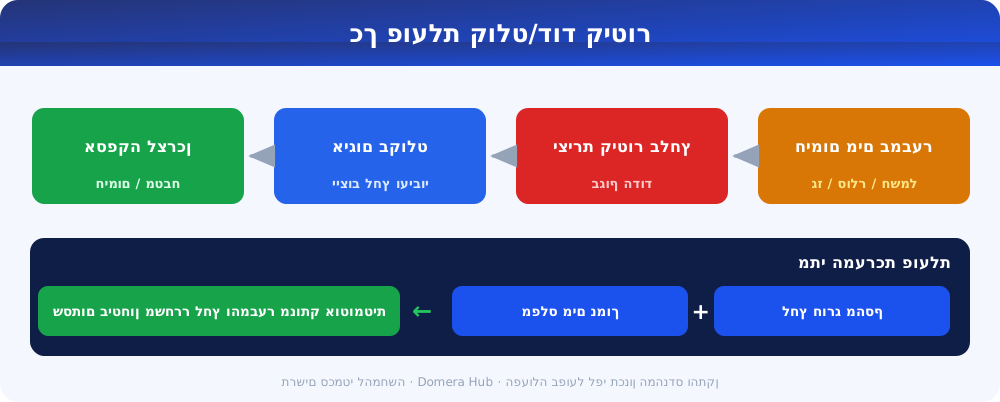
A steam boiler heats water in a burner (gas, diesel or electric) until it turns into pressurized steam. The steam is stored in the body of the boiler and routed through piping to the end consumers — heating coils, heat exchangers, kitchen or laundry equipment. A steam receiver is a collection/separation vessel in the pressure line, whose role is to stabilize pressure, separate condensate and provide a reservoir against sudden load changes. Both components are containment vessels operating under pressure, and therefore are treated as a pressure vessel for all intents and purposes.
The mechanism relies on a safety chain: a pressure and temperature controller adjusts the burner; a relief valve releases excess pressure before it reaches a dangerous threshold; a water-level control prevents a "dry" firing (without water) that may ruin the body; and an automatic shutoff system stops the burner on a fault. The connection of the steam to the consumer and the return of the condensate close a closed loop that conserves energy.
Why the System Is Needed + Risks of Neglect
Steam is the most efficient heating medium for transferring large thermal energy in buildings with an institutional kitchen, a laundry, a heated pool or a production process. Without a sound steam boiler/receiver, essential services come to a halt — and beyond that, it is a first-order safety risk.
A neglected pressure vessel is one of the most severe risks in a building: internal corrosion, scale, wear in the relief valve or a failure in the level control may lead to a fatal explosion (BLEVE), to steam burns and to structural damage. Neglect also entails legal exposure: operating a pressure vessel without a valid inspection report is an offense under the Safety at Work Ordinance, may void insurance coverage in the event of an incident, and expose the building manager and the building owner to personal liability. As with the air-conditioning and heating systems, here too the cost of a preventive inspection is negligible compared with the damage of a failure.
The Maintenance Regime — What, How Often, and How
The inspection regime derives from the component being a pressure vessel, and is documented in each cycle in an inspection report:
- Steam boiler — a testing engineer's inspection: once every 14 months, by a licensed steam-boiler inspector, who issues an inspection report. This is a statutory inspection — without a valid inspection report the boiler must not be operated.
- Steam receiver — a testing engineer's inspection: a statutory inspection by a licensed steam-receiver inspector, who issues an inspection report. The exact cycle frequency must be set according to the current standard and authority and manufacturer guidance.
- Hydrostatic test of an air/steam receiver: required at a 120/72 (months) frequency by a licensed air-receiver inspector, and it is documented in the receiver's inspection report — a test of the airtightness and durability of the body under elevated water pressure.
Alongside the statutory inspections, routine servicing is carried out by a service company on behalf of the manufacturer: scale cleaning, checking the relief valve, calibrating pressure/temperature/level controls, blowdown, and water treatment to prevent corrosion. The frequency of the routine servicing is set according to the manufacturer's guidance — it does not replace the licensed inspector's report but complements it.
Who Is Authorized to Maintain and Certify
The separation here is sharp, because the regulation of pressure vessels is explicit:
- Steam boiler certification — only a licensed steam-boiler inspector may perform the periodic inspection and issue the report.
- Steam receiver certification — only a licensed steam-receiver inspector is authorized to do so.
- Hydrostatic test of the receiver — by a licensed air-receiver inspector, similarly to the pressure vessels and air receivers in the building.
- Routine servicing — a certified technician on behalf of the service company/manufacturer; this is a separate action from the statutory inspection and does not replace the report.
A licensed inspector holds a dedicated certification on behalf of the Chief Labor Inspector; the certification for steam boilers and for steam receivers differ from one another — one must not rely on an inspector who is not licensed for the specific component.
Standards and Regulation
Pressure vessels, including steam boilers and receivers, are subject to the Safety at Work Ordinance and the inspection regulations for pressure vessels, which require a periodic inspection by a licensed inspector and the issuance of a valid inspection report as a condition for operation. Additional structural and operational requirements are set according to the current standard and authority and manufacturer guidance. Since this component does not carry a dedicated fire form within the maintenance matrix, one must not rely on an SI number or clause that does not appear explicitly in the guidance — the binding regulatory reference is the valid inspection report from a licensed inspector.
Required Documentation and Forms
The binding document for each component is the inspection report signed by the licensed inspector — for the steam boiler, for the steam receiver, and for the hydrostatic test of the receiver. The inspection report must be kept accessible in the building file, verified as valid, and its expiration date tracked in order to coordinate a re-inspection in good time. Alongside the report it is recommended to file the routine service reports of the maintenance company. This component has no dedicated fire form — unlike suppression systems such as sprinkler systems — and therefore the core of the evidence is the inspection report itself.
Common Faults and Warning Signs
- A steam/water leak or a whistling sound from the body, the flanges or the valves — a sign of a sealing failure or corrosion.
- A relief valve that "weeps" or is stuck — opening too early (wear) or not opening at all (blockage/scale) — a direct danger.
- Pressure oscillation or recurring burner shutoffs — a problem in the pressure/level control.
- Scale and deposits — impair thermal efficiency and accelerate corrosion; require orderly water treatment.
- An unstable water level or a fault in the level gauge glass — a risk of dry firing.
- An expired inspection report — an immediate halt of operation until re-inspection.
The Value of Professional Maintenance Management / How Domera Helps
A pressure vessel does not tolerate "forgot to coordinate an inspection." Domera manages the component in a PPM program: one open instance per inspection program, closing only against a certifying document (the signed inspection report), an automatic reminder before the expiration of each report, and a compliance report that shows at every moment which reports are valid and which are approaching expiration. Thus the building manager knows that the boiler and the receiver are legal to operate — without relying on memory.
Frequently Asked Questions
How often is a steam boiler inspected?
A testing engineer's inspection for a steam boiler is required once every 14 months, by a licensed steam-boiler inspector who issues an inspection report. Without a valid inspection report the boiler must not be operated.
Who is authorized to inspect a steam receiver / steam boiler?
A steam boiler is inspected by a licensed steam-boiler inspector, and a steam receiver by a licensed steam-receiver inspector. These are separate certifications — one must verify that the inspector is licensed for the specific component.
What is the difference between a steam boiler and a steam receiver?
A steam boiler produces steam by heating water under pressure; a steam receiver is a collection/separation vessel in the pressure line that stabilizes pressure and separates condensate. Both are pressure vessels that require a licensed inspector's check.
What is a hydrostatic test and why is it needed?
A hydrostatic test fills the body with water at elevated pressure in order to check airtightness and structural durability. For an air/steam receiver it is required at a 120/72 month frequency by a licensed air-receiver inspector, and is documented in the receiver's report.
What happens if a steam boiler is operated without a valid inspection report?
This is an offense under the Safety at Work Ordinance, it may void insurance coverage in the event of an incident, and expose the building manager and the building owner to personal liability. Operation must be halted until re-inspection.
Which document must be kept?
The signed inspection report of the licensed inspector — for the boiler, the receiver and the hydrostatic test — accessible in the building file, with tracking of its expiration date.
Is there a fire form for this component?
No. Unlike fire-suppression systems, a steam boiler/receiver has no dedicated fire form; the binding document is the licensed inspector's report under the pressure-vessel laws.
Further Reading
- The complete PPM guide — the process and the matrix: what is inspected in the building, how often, who certifies and which document is kept.
- Air receiver / pressure vessel — the "sibling" pressure vessel, including the hydrostatic test of air and steam receivers and the link to the pre-action system.
- Air-conditioning and heating system maintenance — the broad thermal-mechanical context of heating and air conditioning in the office building.
- Knowledge Hub — all the building-systems and maintenance articles in one place.
Frequently asked questions
How often is a steam boiler inspected?
A testing engineer's inspection for a steam boiler is required once every 14 months, by a licensed steam-boiler inspector who issues an inspection report. Without a valid inspection report the boiler must not be operated.
Who is authorized to inspect a steam receiver / steam boiler?
A steam boiler is inspected by a licensed steam-boiler inspector, and a steam receiver by a licensed steam-receiver inspector. These are separate certifications — one must verify that the inspector is licensed for the specific component.
What is the difference between a steam boiler and a steam receiver?
A steam boiler produces steam by heating water under pressure; a steam receiver is a collection/separation vessel in the pressure line that stabilizes pressure and separates condensate. Both are pressure vessels that require a licensed inspector's check.
What is a hydrostatic test and why is it needed?
A hydrostatic test fills the body with water at elevated pressure in order to check airtightness and structural durability. For an air/steam receiver it is required at a 120/72 month frequency by a licensed air-receiver inspector, and is documented in the receiver's report.
What happens if a steam boiler is operated without a valid inspection report?
This is an offense under the Safety at Work Ordinance, it may void insurance coverage in the event of an incident, and expose the building manager and the building owner to personal liability. Operation must be halted until re-inspection.
Which document must be kept?
The signed inspection report of the licensed inspector — for the boiler, the receiver and the hydrostatic test — accessible in the building file, with tracking of its expiration date.
Is there a fire form for this component?
No. Unlike fire-suppression systems, a steam boiler/receiver has no dedicated fire form; the binding document is the licensed inspector's report under the pressure-vessel laws.