In this article
- How the System Works
- Why the System Is Needed + Risks of Neglect
- The Maintenance Regime — What, How Often, and How
- Who Is Authorized to Maintain and Certify
- Standards and Regulation
- Documentation and Forms
- Common Faults and Warning Signs
- The Value of Professional Maintenance Management / How Domera Helps
- Frequently Asked Questions
- Further Reading
- Frequently asked questions
Roof Davit Crane and Lifting Cradle (BMU) — Maintenance, Inspection Report and Safety
A roof davit crane and lifting cradle — also known as a Building Maintenance Unit (BMU) — is the system fixed on the building's roof that lowers workers and a work platform along the facade, for window cleaning, curtain-wall inspection and maintenance of the building envelope. This is a lifting machine that carries people at heights of tens and hundreds of meters, and therefore in Israel it must be inspected by a licensed lifting-machinery inspector once every six months, producing an inspection report — a legal requirement and not a recommendation. The article explains how the system works, why its maintenance is critical, what the inspection regime is, and who is authorized to certify its operation.
Part of a bigger picture: this system is one component within a complete preventive-maintenance program. For the full framework — all the systems, frequencies, licensed parties and forms — see the complete PPM guide.
For a building manager or maintenance officer, the BMU is one of the few items where a maintenance failure translates directly into a mortal risk to a person suspended in mid-air. There is no room here for "let's push the inspection to next quarter": a lifting cradle without a valid inspection report simply must not be operated.
Part of a bigger picture: the roof crane is one component within a complete preventive-maintenance program. For the full framework — all the systems, frequencies, licensed parties and inspection reports — see the preventive-maintenance (PPM) guides.
How the System Works
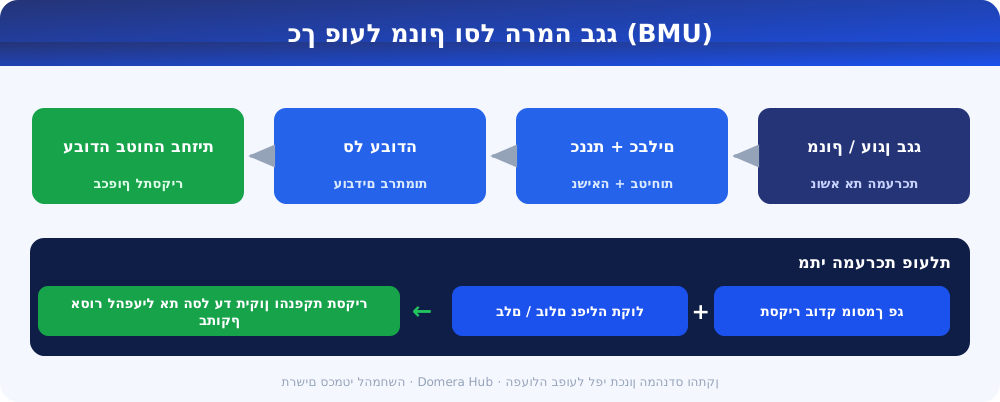
A BMU is not a stationary "scaffold" but a lifting machine that carries people, and its main components are:
- The crane / davit arm (Davit / Roof Car) — the structure on the roof from which the cable extends. It may be a fixed or mobile davit crane, or a roof car that travels on a track around the roof perimeter and provides access to every point on the facade.
- The hoist and ropes (Hoist & Ropes) — the motor that raises and lowers the cradle using steel cables. Many systems have a carrying cable + a separate safety cable, so that even if one cable fails, the second cable and the brake stop the cradle.
- The cradle / work platform (Cradle / Cage) — the compartment in which the workers stand. Equipped with guardrails, harness anchor points, and emergency-stop buttons.
- The safety systems — a fall-arrest device (fall-arrest / rope grab) that automatically catches in free fall, an overload detector, limit switches that stop the cradle at the ends, and an automatic brake in the absence of power.
Operational flow: the workers enter the cradle on the roof, connect via harnesses to the anchor points, and the hoist lowers the cradle along the facade. At every moment, the load transfers from the cradle through the cables to the crane/anchor and to the roof structure — and therefore every link in the chain, from the lifting accessories to the roof anchoring, must be sound and certified. It is important to distinguish: the workers in the cradle are protected by two separate layers — the lifting system itself (the cable and the brake) and the personal fall-arrest system (the harness connected to a lifeline / anchor point), as discussed below.
Why the System Is Needed + Risks of Neglect
In many tall buildings, the BMU is the only way to maintain the envelope: to clean windows and curtain wall, check seals and waterproofing, replace glass and service the facade. Without it there is no safe access to the facade, and neglecting the envelope itself leads to water penetration, wear and even falling cladding pieces.
But the truly severe risk is not in the facade — it is in the cradle itself. A failure in the lifting system while the cradle is suspended in mid-air means a fall of workers from height, an almost always fatal event. Typical failure sources: a carrying cable that has worn and snapped, a brake that did not catch, an overload that was not detected, corrosion in the roof anchor, or a faulty limit switch that kept driving the hoist beyond the limit. Beyond the direct safety risk:
- Heavy legal and criminal liability — operating a lifting cradle without a valid inspection report is a serious breach of the building occupier's safety duties; in an accident, the exposure of the occupier and the work supervisor is especially great when it involves lifting a person.
- Cancellation of insurance coverage — an incident caused by lifting equipment that did not pass an inspection report may void coverage and leave the occupier personally exposed.
- Halting envelope maintenance — a disqualified cradle means the facade cannot be cleaned or repaired until the fault is addressed and a new inspection report is issued.
The Maintenance Regime — What, How Often, and How
According to the mandatory maintenance matrix, the roof davit crane and lifting cradle (BMU) requires an inspection by a licensed lifting-machinery inspector once every six months (every 6 months), producing an inspection report. This is a legal requirement that applies at every site where the system is installed — not a recommendation. Operating the system is permitted only when a valid inspection report exists.
The licensed inspector's inspection is a professional, in-depth check, and in general (according to the current standard and manufacturer/authority guidance) includes: examining the structure of the crane/anchor and the track, the condition of the carrying and safety cables (broken wires, corrosion, wear), the soundness of the hoist and the brakes, checking the fall-arrest device and the limit switches, examining the cradle's anchor points, and sometimes a load test. At its conclusion a verdict is set — fit / disqualified / requires repair — and the system is not operated until the report is valid.
Alongside the legal inspection report, a routine maintenance and inspection regime by the manufacturer/service company is required (lubrication, cable tensioning, brake checks), as well as a visual inspection before every use by the operating team — this procedure does not replace the semi-annual inspection report but serves as an additional layer of protection between inspections. The frequencies of the routine maintenance are set according to the manufacturer's guidance; do not assume a frequency that does not appear in the specification.
Who Is Authorized to Maintain and Certify
The legal inspection and the inspection report are issued solely by a licensed lifting-machinery inspector — holding the dedicated certification for inspecting lifting machinery. This is the only party authorized to determine that the system is fit for operation. It is important to be precise about the fields of certification: the licensed lifting-machinery inspector inspects the crane, the hoist and the cradle, but lifting accessories (straps, shackles, replaceable cables) may require a licensed lifting-accessories inspector, and lifelines and anchor points on the roof are inspected on a separate track. Do not assume that inspecting the crane automatically covers the personal anchoring array as well.
The routine maintenance is performed by a service company certified by the manufacturer, and the visual inspection before use is the responsibility of the operating team — but the official fitness verdict, the one that upholds legal compliance and permits operation, belongs to the licensed inspector alone.
Standards and Regulation
Inspection of the roof davit crane and lifting cradle is a legal (statutory) requirement. The regulatory basis for inspecting lifting equipment in Israel is the Safety at Work Ordinance and its regulations, under which a periodic inspection of lifting machinery by a licensed inspector and the issuance of an inspection report are required. The BMU belongs to the family of "lifting equipment and pressure vessels," all of which are subject to the licensed-inspector inspection regime.
Because the system lifts people, the work-at-height rules also apply to it — training workers, using harnesses and fall-arrest means, and appointing a work supervisor. Regarding a specific Israeli Standard number for a BMU — there is no standard number or dedicated fire form for this system in our requirements matrix, and therefore we do not cite an SI number here; the inspection requirements, disqualification criteria and maintenance intervals are set according to the current standard and manufacturer/authority guidance and at the discretion of the licensed inspector. The inspection report is the binding document.
Documentation and Forms
The document that upholds the system's compliance is the inspection report from the licensed lifting-machinery inspector, issued once every six months. Keep it as a live file with a clear expiration date — the inspection report is the proof, before a regulator or an investigator after an incident, that the system was inspected and certified for operation. Operating the cradle without a valid inspection report is prohibited.
It is recommended to additionally keep the routine maintenance reports of the service company, the log of visual inspections before use, and the workers' work-at-height training certifications. The roof davit crane and lifting cradle has no dedicated fire form — the inspection report is the core of the documentation required for legal compliance.
Common Faults and Warning Signs
- Cables — broken wires in the carrying or safety cable, corrosion, "birdcaging" or kinking, flattening and increased wear on the sheaves. A cable with visible broken wires — an immediate stop until inspection.
- Brakes and fall-arrest device — a brake that does not catch immediately, a fall-arrest device (rope grab) that has not been inspected, or a slow response in emergency stopping. This is the life-saving component and there is no compromising on it.
- Roof anchor and track — corrosion at the anchor base, loose anchor bolts, cracks in the concrete, or a damaged or dirty roof-car track.
- Limit switches and load control — a faulty limit switch that does not stop the cradle at the end, or an overload detector that does not respond. Overload in the cradle = a rupture risk.
- Cradle and guardrails — deformation in the cradle structure, a loose guardrail, a harness anchor point that is not sound, or an emergency-stop button that does not work.
- Operation without a harness or without a valid inspection report — the most serious breach of procedure: working in the cradle without connection to a lifeline / anchor point, or operating when the inspection report has expired.
The Value of Professional Maintenance Management / How Domera Helps
The roof davit crane and lifting cradle demonstrates why maintenance scheduling is not a bureaucratic matter but a matter of human life: an inspection report that has expired and was not renewed in time means the cradle must not be operated — and in practice, that the facade cannot be cleaned until it is addressed, or worse, that someone operated it without noticing that the report had lapsed. Domera's Knowledge Hub is designed to help the maintenance manager see exactly when each certificate expires, before it becomes a problem.
In practice, in Domera the crane inspection is managed through a preventive-maintenance program (PPM): the semi-annual inspection has one instance open at any given moment, and closing it requires attaching the licensed inspector's report. The system sends a reminder before the inspection report expires, and produces compliance reports that show exactly which lifting systems are valid and which are overdue. The idea is simple: close the loop against the certifying document, so that a lifting cradle without a valid inspection report is never put into use inadvertently.
Frequently Asked Questions
What is a BMU?
A Building Maintenance Unit (BMU) is a crane and lifting-cradle system fixed on the building's roof, which lowers workers and a work platform along the facade for window cleaning and envelope maintenance. This is a lifting machine that carries people, and therefore it is subject to stringent safety inspections.
How often must a roof davit crane and lifting cradle be inspected?
Once every six months (every 6 months) by a licensed lifting-machinery inspector, who issues an inspection report. This is a legal requirement, and operating the system is permitted only when a valid inspection report exists.
Who is authorized to inspect and certify the system?
Solely a licensed lifting-machinery inspector — holding the dedicated certification for the field. This is the only party authorized to determine that the system is fit for operation and to issue the inspection report. The routine maintenance is performed by a service company on behalf of the manufacturer.
Is it permitted to operate the cradle without a valid inspection report?
No. Operating a lifting cradle without a valid inspection report is a serious breach of workplace safety duties, endangers human life, and may void insurance coverage and lead to criminal liability of the occupier and the work supervisor.
What is the difference between the service company's maintenance and the licensed inspector's report?
The service company performs routine maintenance (lubrication, adjustment, component replacement) according to the manufacturer's guidance. The licensed inspector performs an independent periodic safety inspection and issues the legal inspection report. The two complement each other — the routine maintenance does not replace the inspection report.
What safety protects the worker in the cradle?
Two separate layers: the lifting system itself (a carrying cable, a safety cable and a fall-arrest device that catches in free fall), and in addition a personal fall-arrest system — a harness that the worker connects to a lifeline or an anchor point. Working in the cradle without connecting a harness is prohibited.
What is the relationship between the crane and the lifelines and anchor points on the roof?
They are complementary systems but are inspected separately: the crane and the cradle are inspected by a licensed lifting-machinery inspector, whereas the lifelines and anchor points on the roof are inspected on a separate engineering track. Both must be valid in order to work safely on the facade.
Is there a fire form or a dedicated Israeli Standard for a roof crane?
Not in our requirements matrix — there is no fire form and no dedicated SI number directed at the roof davit crane and lifting cradle. The binding document is the licensed inspector's report; the inspection requirements are set according to the current standard and manufacturer/authority guidance and under the Safety at Work Ordinance.
Further Reading
- Preventive-maintenance (PPM) guides — how to build a complete preventive-maintenance program for a building, including the roof lifting equipment.
- Lifelines and anchor points — the personal fall-arrest array on the roof, complementing the safety of working in the lifting cradle.
- Lifting accessories (straps, shackles, cables) — the links that actually carry the load in every lift, and their licensed-inspector report regime.
- The building occupier's safety duties — the legal framework for workplace safety, including lifting-equipment inspections and work at height.
- Knowledge Hub — all the guides on building systems in one place.
Frequently asked questions
What is a BMU?
A Building Maintenance Unit (BMU) is a crane and lifting-cradle system fixed on the building's roof, which lowers workers and a work platform along the facade for window cleaning and envelope maintenance. This is a lifting machine that carries people, and therefore it is subject to stringent safety inspections.
How often must a roof davit crane and lifting cradle be inspected?
Once every six months (every 6 months) by a licensed lifting-machinery inspector, who issues an inspection report. This is a legal requirement, and operating the system is permitted only when a valid inspection report exists.
Who is authorized to inspect and certify the system?
Solely a licensed lifting-machinery inspector — holding the dedicated certification for the field. This is the only party authorized to determine that the system is fit for operation and to issue the inspection report. The routine maintenance is performed by a service company on behalf of the manufacturer.
Is it permitted to operate the cradle without a valid inspection report?
No. Operating a lifting cradle without a valid inspection report is a serious breach of workplace safety duties, endangers human life, and may void insurance coverage and lead to criminal liability of the occupier and the work supervisor.
What is the difference between the service company's maintenance and the licensed inspector's report?
The service company performs routine maintenance (lubrication, adjustment, component replacement) according to the manufacturer's guidance. The licensed inspector performs an independent periodic safety inspection and issues the legal inspection report. The two complement each other — the routine maintenance does not replace the inspection report.
What safety protects the worker in the cradle?
Two separate layers: the lifting system itself (a carrying cable, a safety cable and a fall-arrest device that catches in free fall), and in addition a personal fall-arrest system — a harness that the worker connects to a lifeline or an anchor point. Working in the cradle without connecting a harness is prohibited.
What is the relationship between the crane and the lifelines and anchor points on the roof?
They are complementary systems but are inspected separately: the crane and the cradle are inspected by a licensed lifting-machinery inspector, whereas the lifelines and anchor points on the roof are inspected on a separate engineering track. Both must be valid in order to work safely on the facade.
Is there a fire form or a dedicated Israeli Standard for a roof crane?
Not in our requirements matrix — there is no fire form and no dedicated SI number directed at the roof davit crane and lifting cradle. The binding document is the licensed inspector's report; the inspection requirements are set according to the current standard and manufacturer/authority guidance and under the Safety at Work Ordinance.