
In this article
- How the system works
- Why the system is necessary + risks of neglect
- The maintenance regime — what, how often, and how
- Who is qualified to maintain and certify
- Standards and regulation
- Documentation and forms
- Common faults and warning signs
- The value of professional maintenance management / how Domera helps
- Frequently asked questions
- Further reading
- Frequently asked questions
Masts in a Building — Maintenance, Engineer's Inspection and Structural Safety
Masts are the tall steel structures placed on the building's roof or in its yard to carry communications antennas, flags, lighting or observation equipment. Because they are tall structures exposed to wind and changing loads, a failure of their stability may bring them down onto the roof, the facade or passers-by below — and so in Israel they require a qualified engineer's inspection once every five years whose product is a written engineer's certificate, as a legal obligation and not a recommendation. This article explains how a mast stands and why, what the risks of neglect are, what the inspection regime is, and who is qualified to certify its stability.
Part of a bigger picture: masts are one component within a complete preventive maintenance program. For the full framework — all the systems, frequencies, qualified parties and surveys — see the complete PPM guide.
For a building manager or maintenance officer, the mast is an easy item to forget: it stands there for years without moving, until hidden corrosion or a loose bolt turns it into a risk. Unlike a system whose fault is felt immediately (an elevator that gets stuck, a generator that fails to start), a mast fails quietly — and all at once.
How the system works
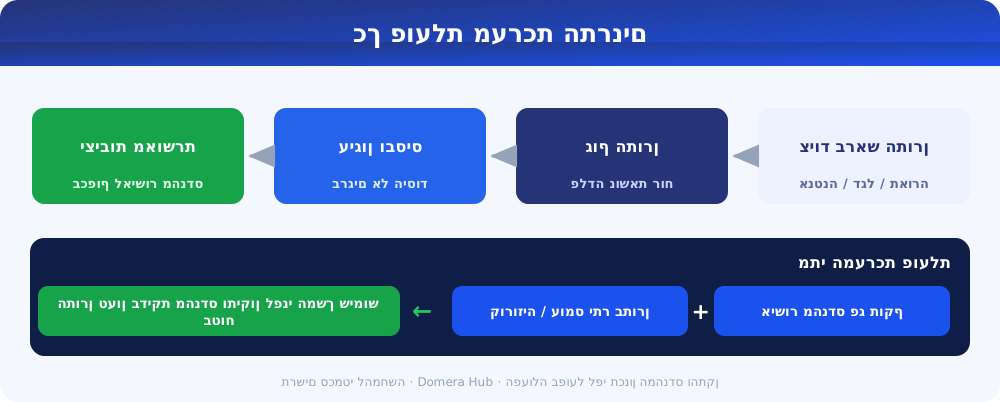
A mast is not a simple "pole" but a load-bearing structure whose function is to hold equipment at height against wind forces. Its main components:
- The mast body (the structure) — a steel tube, a lattice (welded truss) or a stepped mast. The height, cross-section and wall thickness are determined so that they withstand the design wind load of the site.
- The anchorage and base — a base plate and anchor bolts (anchors) that tie the mast to a concrete foundation or to the roof frame. Here the entire load passes into the structure — and here too most of the failure risks are concentrated (corrosion, loose bolts, a crack in the foundation).
- Uprights and tensioners (as needed) — in tall or slender masts, guy wires are added that anchor the mast to the sides and stabilize it against the wind.
- The equipment at the top of the mast — antennas, flags, lighting fixtures or dishes. Their weight and their exposed surface area to the wind (the "sail") increase the load on the structure, and so every added piece of equipment may exceed the original design.
The flow of forces is simple but uncompromising: the wind pushes on the equipment and the mast body, this force intensifies with height and accumulates as a moment (a "lever arm") acting on the base, and the entire load ultimately reaches the anchor bolts and the foundation. A single weak link is enough — a corroded bolt, a cracked weld, a slack guy wire — for the whole structure to lose stability in a strong wind. For this reason the mast is tightly bound to the structural stability and resilience of the building: it must not be treated as an accessory, but as a structural element in every respect.
Why the system is necessary + risks of neglect
Masts are the infrastructure that enables essential services on the roof: reception and transmission of cellular and communications antennas, warning lighting, carrying flags and observation equipment. But their entire value is conditioned on their stability — an unstable mast is not "infrastructure," it is a dangerous nuisance.
The severe risk in neglecting a mast is collapse or parts falling from height. A mast that collapses in the wind, or equipment that detaches from its top, falls onto the roof, the facade or the sidewalk and street below — an event that may cause injury to life and heavy property damage. The typical sources of failure: corrosion in the base and connections (especially in a marine/salty climate), loose or rusted anchor bolts, cracks in welds or in the concrete foundation, slackened guy wires, and overload from adding antennas or equipment beyond the design. Beyond the direct safety risk:
- Legal liability of the occupier — a mast or equipment falling from the roof exposes the building occupier and the maintenance manager to civil and criminal liability, particularly if the required periodic inspection was not carried out.
- Insurance exposure — damage caused by a structure that was not inspected as required may impair insurance coverage and leave the occupier exposed.
- A secondary risk — a lightning strike — a tall metal mast is the natural attraction point for lightning. A mast that is not properly connected to the earthing array may itself become dangerous, and so it is important to coordinate mast maintenance with the building's lightning protection system.
The maintenance regime — what, how often, and how
Per the mandatory maintenance matrix, masts require an inspection once every five years (quinquennial) by a qualified engineering party, whose product is an engineer's certificate that includes a register of the masts, their height and their location on the site. This is a legal (statutory) requirement applying at every site where masts are installed.
The engineer's inspection is a professional structural examination, and generally (per the current standard and the manufacturer's/authority's guidance) includes: examining the condition of the mast body and connections, detecting corrosion and wear, checking the anchor bolts and base, examining welds, checking the tension of the guy wires if any exist, and verifying that the equipment at the top of the mast does not exceed the design load. At its conclusion, the engineer issues a certificate on the stability of the structure — or determines that a repair is required.
It is important to understand that the five-year cycle is the maximum legal inspection interval, not a substitute for ongoing vigilance. Between inspections it is recommended to carry out a periodic visual examination by the maintenance team (signs of rust, exposed bolts, slack wires), and especially after strong wind events or the addition of equipment — any change in load may justify an earlier engineering inspection than the planned date. The frequencies of the visual examination are not fixed in the matrix; do not assume a frequency that does not appear in the specification or the engineer's guidance.
Who is qualified to maintain and certify
The legal inspection and the stability certificate are issued by a qualified engineering party: a licensed inspector, mechanical engineer or registered civil engineer — according to the nature of the structure. This is the only party authorized to determine that the mast is stable and safe for use, and to document the mandatory register (the list of masts, their height and their location).
Installing, dismantling or modifying a mast — including adding an antenna or equipment — is not routine maintenance work: it changes the load on the structure, and so it should be carried out with engineering support and documented. The internal maintenance team can and should carry out a visual examination and report findings, but the official stability ruling — the certificate that upholds legal compliance — belongs to the qualified engineer only.
Standards and regulation
Mast inspection is a legal (statutory) requirement and belongs in the matrix to the "engineer's inspections" family — periodic structural inspections performed by a qualified engineering party on safety-related elements in the building. The basis for the requirement stems from the building occupier's duty to verify the stability of the structures and installations under their control.
Regarding a specific SI number for masts — our requirements matrix contains no Israeli standard number or dedicated fire-service form directed at masts, and so we do not cite an SI number here. The inspection criteria, its intervals beyond the five-year cycle, and the design requirements (for example the design wind load) are determined per the current standard and the manufacturer's/authority's guidance and according to the professional judgment of the qualified engineer. It should be remembered that alongside structural stability, a tall metal mast is required to be integrated into the building's lightning protection array — a matter inspected in a separate track.
Documentation and forms
The document that upholds the system's compliance is the engineer's certificate, and its distinctive feature is that it includes a full register of the masts — their number, their height and their location on the site. This register is not merely a technical detail: it is the official "inventory" that makes it possible to verify that every mast was inspected, and to identify undocumented additions. Keep the certificate as a live file with the inspection date and the next inspection date, as proof before a regulator or an investigator after an event.
Masts have no dedicated fire-service form — the engineer's certificate is the core of the documentation required for legal compliance. It is recommended to additionally keep the original installation documentation, any engineering certificate for the addition of equipment, and the records of the ongoing visual examinations.
Common faults and warning signs
- Corrosion — rust in the mast body, in the connections and especially in the base and the anchor bolts. In marine/salty areas the corrosion is accelerated. Rust stains dripping from the base are a red flag.
- Anchor bolts and welds — loose bolts, missing nuts, a crack or peeling in a weld, or movement of the base plate. The base connection is the critical point of failure.
- The concrete foundation — cracks around the base, crumbling concrete or evidence of movement — a sign that the anchorage has lost its grip.
- Guy wires — a slack, rusted, frayed or disconnected wire. Uneven tension loads the mast asymmetrically.
- Abnormal sway or oscillation — a mast that sways or "vibrates" in moderate wind beyond what is acceptable indicates a loss of rigidity or a faulty connection.
- Undocumented overload — antennas or equipment added since the installation without an engineering inspection. Every addition increases the wind load and the structure may no longer be within the design range.
The value of professional maintenance management / how Domera helps
The mast illustrates the classic problem of preventive maintenance: an item that does not "complain," a long five-year inspection interval, and a single certificate that is easy to forget until it expires — or until the wind reminds you of it. Domera's Knowledge Hub is designed to help the maintenance manager see exactly when each certificate expires, even when the next date is years away.
In practice, at Domera the mast inspection is managed through a preventive maintenance program (PPM): one open instance is opened at any given moment for the five-year inspection, and its closure requires attaching the engineer's certificate on the stability of the masts. The system sends a reminder before the certificate expires, and produces compliance reports that show which structural inspections are valid and which are overdue. The idea is simple: close the loop against the certifying document, so that a five-year stability inspection does not fall between the cracks merely because the time interval is long.
Frequently asked questions
What are masts in the context of a building?
Masts are tall steel structures placed on the roof or in the yard of the building to carry communications antennas, flags, lighting fixtures or observation equipment. Because they are tall structures exposed to wind loads, they are considered a structural element requiring periodic inspection.
How often must masts be inspected?
Once every five years (quinquennial) by a qualified engineering party, who issues an engineer's certificate that includes a register of the masts, their height and their location. This is a legal requirement applying at every site where masts are installed.
Who is qualified to inspect and certify masts?
A licensed inspector, mechanical engineer or registered civil engineer — according to the nature of the structure. This is the only party authorized to determine that the mast is stable and safe, and to document the mandatory register. The official stability ruling belongs to the qualified engineer only.
What does the engineer's certificate include?
A certificate on the mast's stability, and especially a full register of the masts — their number, their height and their location on the site. This register is the official "inventory" that makes it possible to verify that every mast was inspected and to identify undocumented equipment additions.
Is it permitted to add an antenna or equipment to an existing mast?
Not freely. Every addition of equipment increases the mast's weight and its exposed surface area to the wind, and may exceed the design load. Adding equipment should be accompanied by an engineering inspection confirming that the structure is still within the design range.
What is the connection between masts and lightning protection?
A tall metal mast is the natural attraction point for lightning, and so it must be properly integrated into the building's lightning protection and earthing array. Mast maintenance and the lightning protection system should be coordinated, but they are inspected in separate tracks.
Is there a fire-service form or dedicated SI for masts?
Not in our requirements matrix — there is no fire-service form nor dedicated SI number directed at masts. The mandatory document is the engineer's certificate; the inspection requirements and design criteria are determined per the current standard and the manufacturer's/authority's guidance and the professional judgment of the qualified engineer.
Further reading
- The complete PPM guide — how to build a complete preventive maintenance program for the building, including the periodic engineer's inspections.
- Structural stability and resilience of the building — the broad structural context within which the mast is a load-bearing element in every respect.
- Lightning protection — why a tall metal mast must be integrated into the building's lightning protection and earthing array.
- Knowledge Hub — all the guides on the building's systems in one place.
Frequently asked questions
What are masts in the context of a building?
Masts are tall steel structures placed on the roof or in the yard of the building to carry communications antennas, flags, lighting fixtures or observation equipment. Because they are tall structures exposed to wind loads, they are considered a structural element requiring periodic inspection.
How often must masts be inspected?
Once every five years (quinquennial) by a qualified engineering party, who issues an engineer's certificate that includes a register of the masts, their height and their location. This is a legal requirement applying at every site where masts are installed.
Who is qualified to inspect and certify masts?
A licensed inspector, mechanical engineer or registered civil engineer — according to the nature of the structure. This is the only party authorized to determine that the mast is stable and safe, and to document the mandatory register. The official stability ruling belongs to the qualified engineer only.
What does the engineer's certificate include?
A certificate on the mast's stability, and especially a full register of the masts — their number, their height and their location on the site. This register is the official 'inventory' that makes it possible to verify that every mast was inspected and to identify undocumented equipment additions.
Is it permitted to add an antenna or equipment to an existing mast?
Not freely. Every addition of equipment increases the mast's weight and its exposed surface area to the wind, and may exceed the design load. Adding equipment should be accompanied by an engineering inspection confirming that the structure is still within the design range.
What is the connection between masts and lightning protection?
A tall metal mast is the natural attraction point for lightning, and so it must be properly integrated into the building's lightning protection and earthing array. Mast maintenance and the lightning protection system should be coordinated, but they are inspected in separate tracks.
Is there a fire-service form or dedicated SI for masts?
Not in our requirements matrix — there is no fire-service form nor dedicated SI number directed at masts. The mandatory document is the engineer's certificate; the inspection requirements and design criteria are determined per the current standard and the manufacturer's/authority's guidance and the professional judgment of the qualified engineer.