In this article
- How the System Works
- Why the System Is Needed + Risks of Neglect
- The Maintenance Regime — What, How Often, and How
- Who Is Licensed to Maintain and Certify
- Standards and Regulation
- Required Documentation and Forms
- Common Faults and Warning Signs
- The Value of Professional Maintenance Management / How Domera Helps
- Frequently Asked Questions
- Further Reading
- Frequently asked questions
Lightning Protection — Protecting the Building from a Lightning Strike
Lightning protection is a system whose role is to capture the lightning strike at a controlled point at the top of the building and to drain its enormous electrical current in a safe and planned way to the ground — instead of the lightning finding itself a random path through the structure, the electrical systems or the people in it. In doing so the system protects the integrity of the structure, the lives of its occupants, and the electrical, communications and elevator systems from damage and fire.
For a building manager or maintenance engineer, lightning protection is a "quiet" safety component: on most days it does nothing, but at the moment of truth — a single lightning strike — it is the difference between a managed event and a fire, a system shutdown or a loss of life. Because the system sits outside and is exposed to all the ravages of the weather, its soundness is not to be taken for granted and requires periodic inspection. This article explains how the system works, why maintaining it matters, what the inspection regime is in Israel, who is licensed to inspect and certify it, and how to manage all of it without missing a certificate.
Part of a bigger picture: lightning protection is one component within a complete preventive-maintenance program. For the full framework — all the systems, frequencies, licensed parties and documents — see the complete PPM guide.
How the System Works
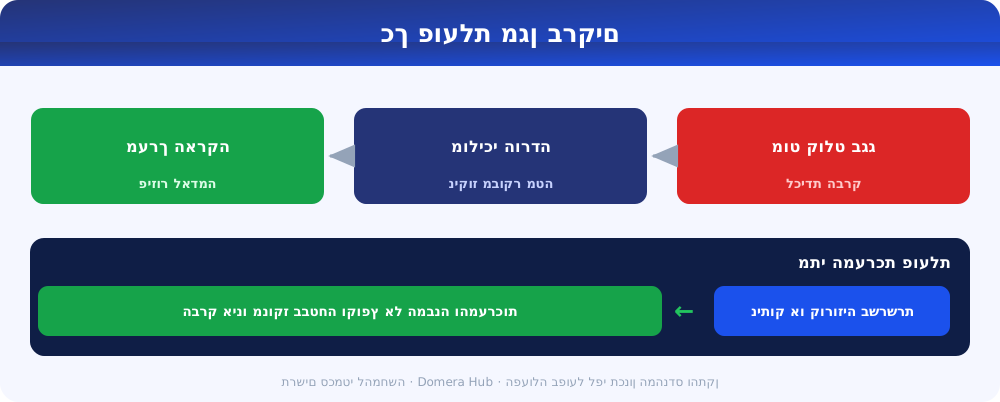
The principle behind lightning protection is simple and elegant: give the lightning a preferred path. Lightning is an enormous electrical discharge that seeks the shortest and most conductive path to the ground. If it is not given a planned path, it will pass through whatever is at hand — a wall, an electrical system, piping or a person. Lightning protection builds for it in advance a path safer than all of these, and conducts the current to the ground without harming the structure.
The system is composed of three main parts, connected into one continuous chain:
- The capture installation (rods / air terminals on the roof) — lightning rods and conductors at the high and exposed points of the roof, whose role is to "attract" and capture the lightning strike at a controlled, non-random point.
- The down conductors — large-cross-section conductors descending from the roof along the structure that carry the lightning current downward along a defined path, away from sensitive systems.
- The earthing array — electrodes and conductors in the ground, which disperse the lightning current to the ground quickly and safely. This is the final destination of the current.
The three parts must form a continuous conductive chain — capture, drainage, dispersal. Any break, corrosion or loose connection along the way breaks the path and forces the lightning to seek an alternative route — exactly what the system is meant to prevent. For this reason, lightning protection is tightly linked to the building's earthing: the earthing array is the common basis, and the system's proper filtering relies on the same principle of a reliable conductive path to the ground that appears also in the maintenance of the building's electrical system and earthing.
Why the System Is Needed + Risks of Neglect
Lightning protection is needed because a direct lightning strike releases enormous energy in a fraction of a second. Without a planned path, that same energy can ignite a fire, blast concrete (from the vaporization of internal moisture), burn electrical and communications systems, and endanger human life. The more tall, isolated or exposed the building is — the higher the risk of a strike.
But here is the critical point: a faulty lightning-protection system is sometimes more dangerous than the absence of a system. If a down conductor is disconnected, cut during roof work, or the earthing array has worn away from corrosion — the system still "invites" the lightning to itself through the capture installation, but is no longer able to drain it safely. The result: the current jumps into the structure or the systems instead of flowing to the ground. Therefore continuous soundness is not a luxury but a condition for the very logic of the system.
Neglecting maintenance creates three types of risk:
- Safety and fire. A lightning strike on a faulty system can cause a fire, structural damage and injury to the building's occupants.
- Damage to systems. A voltage surge from lightning that was not properly drained can burn distribution boards, communications, control, elevator and computing systems — with a shutdown and heavy financial damage.
- Liability and insurance. The absence of a valid inspection certificate for the lightning protection can complicate insurance coverage in the event of lightning damage, and create exposure for the committee and the management company for a maintenance failure.
The Maintenance Regime — What, How Often, and How
Lightning protection has one clear central inspection requirement:
- Lightning-protection inspection — annual (every 12 months). A periodic inspection of the system's soundness and all its parts — the capture installation on the roof, the down conductors and the earthing array — and an examination of the conductivity continuity along the entire chain and the quality of the resistance to the ground. The inspection verifies that the path from roof to ground is intact, well connected, and free of corrosion and breaks. The document to produce and keep: a lightning-protection inspection certificate.
It is important to be precise about the status: per the requirements matrix, the lightning-protection inspection is a recommendation and not a statutory legal requirement for every structure. That said, we strongly recommend against skipping it — this is a safety system whose failure, as explained, can be more dangerous than its absence. Beyond that, certain structures are subject to specific compliance and licensing requirements (see below), and insurance expects regular maintenance. The recommended frequency is annual, and in addition it is worth performing a visual inspection after any known lightning event or roof work that could damage the conductors.
Who Is Licensed to Maintain and Certify
A lightning-protection inspection is not an inspection that every electrician or maintenance worker performs offhand. The inspection and certification are reserved for a lightning-protection-systems inspector — a party with the dedicated knowledge and equipment to measure conductivity continuity and earthing resistance and to assess the soundness of the array as a whole.
The practical meaning for the building manager:
- The annual inspection and the lightning-protection inspection certificate are produced by a lightning-protection-systems inspector alone — not a general maintenance worker and not just any electrician.
- During roof work (waterproofing, HVAC, antennas, a ladder, structural reinforcements), make sure no one disconnects, cuts or moves a lightning-protection conductor — and if they do, schedule a re-inspection.
- If the building has undergone a change in height, an added storey, the installation of large equipment on the roof or masts — it is worth verifying that the lightning protection still covers all the exposed points.
Standards and Regulation
Lightning-protection inspection is subject to the current standard and manufacturer instructions and to the accepted principles of lightning-protection design and protection. In our requirements matrix this inspection is marked as a recommendation and not as a universal legal requirement — and therefore, in accordance with our truth rules, we will not cite here a specific SI number or a dedicated legal clause that does not appear in the binding source. The practical and clear requirement is: performing an annual inspection by a lightning-protection-systems inspector, and producing a lightning-protection inspection certificate.
Beyond that, there are structures and uses (for example tall buildings, public buildings or facilities with special risk) in which the lightning-protection requirement may arise from the building permit, from licensing requirements or from a dedicated binding standard. In every such case one should act per the standard and the guidance of the competent authority and the manufacturer relevant to the structure, and not rely on a sweeping generalization.
Required Documentation and Forms
The document that holds the system's compliance is one and clear: a lightning-protection inspection certificate, signed by a lightning-protection-systems inspector. Manage it as a living file with an expiry date, and refresh it each year with the re-inspection.
Unlike some suppression and safety systems, lightning protection has no dedicated fire-service form — so there is no link to a fire-service form here. That said, it is worth keeping the lightning-protection inspection certificate together with the building's electrical and earthing file (electrical installation inspection, earthing inspection, electrical certificates), because all of these are examined as a whole in the event of lightning damage, an authority audit or an insurance claim. From the perspective of a regulator, insurer or investigator — a valid inspection certificate is the proof that the system was inspected and maintained as required.
Common Faults and Warning Signs
- A disconnected, cut or loosened down conductor — the most common cause of failure, usually following roof work or wear. Breaks the continuity of the path — the system "invites" lightning but does not drain it.
- Corrosion in connections and rods — the system is exposed to the weather; rust increases the electrical resistance and impairs the conducting ability.
- A deteriorating earthing array / high earthing resistance — if the current does not disperse to the ground quickly, it may return to the structure; detected mainly by measurement in the annual inspection.
- A change on the roof without updating the protection — added equipment, antennas, masts or a storey that created new exposed points not covered by the existing capture installation.
- An expired or missing inspection certificate — a safety and insurance exposure, and a sign that the system has not been inspected for some time and its condition is unknown.
The Value of Professional Maintenance Management / How Domera Helps
Lightning protection is exactly the kind of system that is easy to "forget" — it makes no noise, no lamp lights up when it breaks, and most of the time nothing happens. But when a lightning strike arrives, it is already too late to discover that a conductor was disconnected two years ago during waterproofing work. The value of professional maintenance management is that this system does not rest on anyone's memory.
In Domera, lightning protection is managed through a preventive-maintenance program (PPM): for the annual inspection a single open instance is opened at any given moment, and closing it requires attaching the lightning-protection inspection certificate from the licensed inspector. The system sends a reminder before expiry of the certificate and produces compliance reports that show exactly whether the system is valid or overdue. The idea is simple: close the loop against the certifying document, not against a gut feeling — so that the lightning-protection inspection does not "fall through the cracks" until the next storm.
Frequently Asked Questions
What is lightning protection and why is it important?
Lightning protection is a system that captures a lightning strike at a controlled point at the top of the building and drains the enormous current to the ground along a safe, planned path. It is important because without it the lightning may pass through the structure, the electrical systems or people, and cause a fire, damage and electrocution.
How often is lightning protection inspected?
The recommended inspection is once a year (every 12 months). In addition, it is worth performing a visual inspection after any known lightning event or after roof work that could damage the system's conductors.
Who is licensed to inspect and certify lightning protection?
A lightning-protection-systems inspector — a party with the dedicated knowledge and equipment to measure conductivity continuity and earthing resistance. This is who performs the annual inspection and produces the lightning-protection inspection certificate; not a general maintenance worker or just any electrician.
Is a lightning-protection inspection a legal obligation?
Per the requirements matrix, a lightning-protection inspection is marked as a recommendation and not as a universal legal requirement. That said, in certain structures the protection requirement may arise from the building permit, from licensing or from a dedicated standard — and then one should act per the standard and the guidance of the authority and the manufacturer. It is strongly recommended to perform the inspection in any case.
What are the parts of a lightning-protection system?
Three parts connected into a continuous chain: the capture installation (rods/air terminals on the roof) that catches the lightning, the down conductors that carry the current downward, and the earthing array that disperses it to the ground. Any break along the chain breaks the protection.
Is a faulty lightning-protection system dangerous?
Yes, and sometimes more so than the absence of a system. If a conductor is disconnected or the earthing array has worn away, the system still invites the lightning through the capture installation but is unable to drain it safely — so the current jumps into the structure or systems instead of flowing to the ground. Therefore continuity and periodic inspection are critical.
What is the connection between lightning protection and the building's earthing?
The earthing array is the common basis for both. Lightning protection relies on a reliable conductive path to the ground, exactly like electrical earthing, and therefore inspecting conductivity continuity and earthing resistance is at the heart of the system's annual inspection.
Which document must be kept for the lightning protection?
A lightning-protection inspection certificate, signed by a lightning-protection-systems inspector. It should be kept as a living file with an expiry date, refreshed each year, and held together with the building's electrical and earthing file.
Further Reading
- The PPM guide — how to build a complete preventive-maintenance program for a building, with all the systems, frequencies and licensed parties.
- Building electrical systems maintenance — the overall picture of the electrical installation, the earthing and the periodic inspections to which lightning protection connects.
- Standard 413 for earthquake resistance — a look at structural resilience and the engineering requirements of the envelope, alongside protection from natural hazards.
- The Knowledge Hub — all the guides on building systems in one place.
Frequently asked questions
What is lightning protection and why is it important?
Lightning protection is a system that captures a lightning strike at a controlled point at the top of the building and drains the enormous current to the ground along a safe, planned path. It is important because without it the lightning may pass through the structure, the electrical systems or people, and cause a fire, damage and electrocution.
How often is lightning protection inspected?
The recommended inspection is once a year (every 12 months). In addition, it is worth performing a visual inspection after any known lightning event or after roof work that could damage the system's conductors.
Who is licensed to inspect and certify lightning protection?
A lightning-protection-systems inspector — a party with the dedicated knowledge and equipment to measure conductivity continuity and earthing resistance. This is who performs the annual inspection and produces the lightning-protection inspection certificate; not a general maintenance worker or just any electrician.
Is a lightning-protection inspection a legal obligation?
Per the requirements matrix, a lightning-protection inspection is marked as a recommendation and not as a universal legal requirement. That said, in certain structures the protection requirement may arise from the building permit, from licensing or from a dedicated standard — and then one should act per the standard and the guidance of the authority and the manufacturer. It is strongly recommended to perform the inspection in any case.
What are the parts of a lightning-protection system?
Three parts connected into a continuous chain: the capture installation (rods/air terminals on the roof) that catches the lightning, the down conductors that carry the current downward, and the earthing array that disperses it to the ground. Any break along the chain breaks the protection.
Is a faulty lightning-protection system dangerous?
Yes, and sometimes more so than the absence of a system. If a conductor is disconnected or the earthing array has worn away, the system still invites the lightning through the capture installation but is unable to drain it safely — so the current jumps into the structure or systems instead of flowing to the ground. Therefore continuity and periodic inspection are critical.
What is the connection between lightning protection and the building's earthing?
The earthing array is the common basis for both. Lightning protection relies on a reliable conductive path to the ground, exactly like electrical earthing, and therefore inspecting conductivity continuity and earthing resistance is at the heart of the system's annual inspection.
Which document must be kept for the lightning protection?
A lightning-protection inspection certificate, signed by a lightning-protection-systems inspector. It should be kept as a living file with an expiry date, refreshed each year, and held together with the building's electrical and earthing file.