In this article
- How the system works
- Why the system is needed + risks of neglect
- The maintenance regime — what, how often, and how
- Who is qualified to maintain and certify
- Standards and regulation
- Required documentation and forms
- Common faults and warning signs
- The value of professional maintenance management / how Domera helps
- Frequently asked questions
- Further reading
- Frequently asked questions
An escalator is a system of moving stairs that continuously carries people between two adjacent levels in a building. It is needed to move a large crowd safely and comfortably in shopping centers, office complexes and public buildings, and because it carries people in constant motion — it is considered lifting equipment that requires meticulous maintenance and periodic soundness inspection.
This article explains, from a maintenance manager's point of view, how the escalator operates, why neglecting it is dangerous, what maintenance regime is required, who is qualified to maintain and certify it, and which documents must be kept in the building file.
The escalator is one component of the building's preventive maintenance plan. For the full picture of the method, frequencies and responsibility — see the full PPM guide.
How the system works
An escalator is built from a train of metal steps connected to two continuous drive chains (step chains), moving in a closed loop along guide rails. At the upper end is the machine room: an electric motor, a gearbox and a main drive sprocket that drive the step train. Alongside the steps move two flexible handrails on rollers, synchronized to the speed of the steps to support the passenger.
At the ends are the comb plates — grooved "combs" into which the teeth of the step enter at entry and exit, preventing objects or fingers from being caught in the gap. Along the sides stand the balustrades with safety brushes at their base. The internal control includes a chain of safety measures: emergency stops at the ends, over-speed sensors, an unintended reversal-of-travel sensor, and switches that detect a broken step chain, a foreign object entering the comb, or a stalled handrail — each of which stops the escalator immediately.
The central safety principle is essentially similar to that of the elevator system: a powerful drive mechanism that is always under the supervision of an independent safety layer, whose role is to shut down the motion the moment something deviates from the sound parameters.
Why the system is needed + risks of neglect
The escalator moves crowds between levels continuously and reduces the load on elevators and stairs — critical in buildings with high foot traffic. But precisely because it carries people in motion, any fault immediately becomes a safety risk.
Neglecting maintenance can cause: wear and stretching of the step chains up to breakage; wearing of the combs and the creation of a gap in which fingers, shoes or the edges of clothing are caught; a failure in handrail synchronization that throws passengers; and the bypassing or failure of the safety switches — at which point a small event turns into a serious accident. Beyond bodily harm, operating an escalator without a valid inspection report exposes the building holder to criminal and civil liability and to the voiding of insurance coverage in the event of damage. As in any preventive maintenance plan, this is exactly the kind of risk that is averted cheaply when it is maintained on schedule, and explodes expensively when it is not.
The maintenance regime — what, how often, and how
The escalator system has two complementary maintenance tracks operating in parallel:
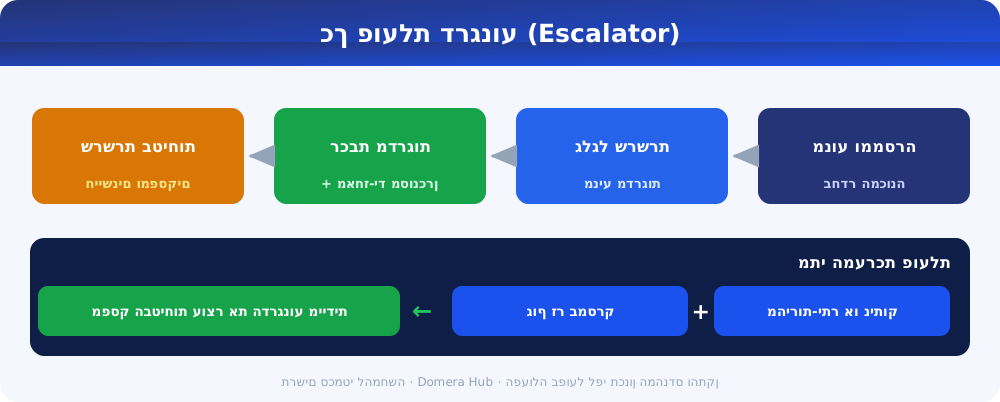
- Licensed inspector inspection — once a year (annual). Per the matrix, the escalator requires a periodic inspection by a licensed escalator inspector, at the end of which an inspection report is issued. This is the soundness inspection required by law, which is a condition for the continued operation of the escalator.
- Ongoing service by the maintenance company — throughout the year. The service company performs routine preventive maintenance: lubricating and adjusting the chains, checking tension, cleaning the comb tracks, checking the brakes and safety switches, and checking handrail synchronization. These actions are performed per the manufacturer's directive and at a higher frequency than the annual inspection, to ensure that the system reaches the licensed inspector inspection in sound condition.
The logic is identical to what is customary in elevator standards: the licensed inspector certifies soundness on a fixed cycle, while the maintenance company keeps the system in shape between one inspection and the next. Both tracks are essential — one does not replace the other.
Who is qualified to maintain and certify
Two roles must be distinguished:
- Licensed escalator inspector — the only party authorized to perform the periodic inspection and issue the inspection report. This is a licensed inspector dedicated to the escalator field, similar to the qualification structure of a licensed inspector for elevators and other lifting equipment. Only a report on their behalf constitutes a soundness certificate for the purposes of the law.
- Maintenance company / service technician — performs the ongoing maintenance and repairs, but does not replace the licensed inspector and does not issue an inspection report.
The choice of the performing party must be backed by qualification and specific experience with escalators — not every elevator technician is also qualified for escalators. The details of the qualification requirements are set per the current standard and the directive of the competent authority.
Standards and regulation
The escalator is classified as lifting equipment, and its periodic inspection by a licensed inspector is a statutory requirement (mandatory by law) — exactly as it appears in the PPM matrix: the annual inspection is marked as statutory. The framework of inspection by a licensed inspector and the issuance of a report is derived from the occupational safety laws applicable to lifting equipment.
The installation, performance and safety measure requirements of the escalator itself are set per the relevant Israeli standard and per the current manufacturer and competent authority directive. Since a specific standard number does not appear in the binding facts block, an exact SI number must not be cited — one must act according to the standard and the manufacturer/authority directives in force at the time of the inspection.
Required documentation and forms
The binding document that must be kept in the building file is the inspection report of the licensed escalator inspector, valid. A valid report is the condition for the lawful operation of the escalator, and it must be available for audit at any time.
In addition, it is recommended to file the periodic service reports of the maintenance company and the record of repairs and defects, in order to show a complete maintenance continuity between one inspection and the next. The escalator has no dedicated fire form in the matrix — unlike certain systems to which a fire form is attached — so the report is the central compliance document.
Common faults and warning signs
- Abnormal noise or vibration — knocking, squeaking or a "jumping" sensation in the steps usually indicates a chain that is too tight/too loose or wear in the step rollers.
- An unsynchronized handrail — a handrail moving slower than the steps (or stalled) is a dangerous warning sign that throws passengers, and requires immediate attention.
- A gap or break in the comb — a broken comb tooth or a gap between the step and the comb plate increases the risk of entrapment; stop and repair.
- Missing/damaged safety brushes at the base of the balustrade — invite clothing being pulled to the sides.
- An emergency stop or sensor that does not respond — any failure in the safety layer requires shutdown until repaired; do not operate an escalator with a disabled safety.
- Wear, sinking or spacing between steps as well as faded yellow demarcation lines at the ends — impair the safety of stepping.
The value of professional maintenance management / how Domera helps
The common failure in an escalator is not technical but managerial: losing track of the report's expiry date, confusion between ongoing service and the statutory inspection, and missing documentation at the time of an audit. Domera addresses this as part of the PPM plan: the escalator is registered as a system with a single open maintenance instance at any given time, closing the instance is conditional on attaching the certifying document (the report or the service report), and the system sends a reminder before a certificate expires as well as consolidated compliance reports. This way the building manager always knows that the report is valid and that the documentation is ready for audit — without manual tracking.
Frequently asked questions
How often is an escalator inspected?
A licensed escalator inspector inspection is required once a year (an annual inspection), at the end of which an inspection report is issued. In parallel, ongoing service by the maintenance company is carried out throughout the year.
Who is qualified to inspect and certify an escalator?
Only a licensed escalator inspector is permitted to perform the periodic inspection and issue the inspection report. The maintenance company performs service and repairs but does not issue a report.
What is an inspection report and why is it important?
The inspection report is the soundness document issued by the licensed inspector. A valid report is the legal condition for operating the escalator and the central compliance document that must be kept in the building file.
What is the difference between the annual inspection and the maintenance company's service?
The annual inspection is a statutory soundness certification by a licensed inspector; the ongoing service is preventive maintenance (lubrication, adjustment, safety checks) that the maintenance company performs between one inspection and the next. Both are essential and do not replace one another.
Is it permitted to operate an escalator without a valid report?
No. Operating an escalator without a valid inspection report is not lawful, exposes the building holder to liability, and may void insurance coverage in the event of damage.
What is the difference between an escalator and an elevator in terms of inspection?
Both are lifting equipment that require a licensed inspector inspection and a report, but these are separate qualifications and inspection cycles — a licensed escalator inspector for the escalator, an annual inspection; and a licensed elevator inspector for the elevator, on a separate cycle.
What are the warning signs that require stopping an escalator immediately?
Abnormal noise, an unsynchronized handrail, a broken comb tooth or a dangerous gap, and any failure in an emergency stop or safety sensor — all require shutdown until repaired.
Further reading
- Elevator maintenance and licensed inspector inspection — the closest sister system: a licensed inspector report versus the elevator company's service, and the identical logic of periodic safety supervision.
- Elevator maintenance standards — the framework of standards and inspection of people-carrying equipment, background for understanding the inspection requirements of the escalator as well.
- The full PPM guide — the preventive maintenance method, the frequency and responsibility matrix to which the escalator belongs.
- Domera's Knowledge Center — all the building systems and maintenance articles in one place.
Frequently asked questions
How often is an escalator inspected?
A licensed escalator inspector inspection is required once a year (an annual inspection), at the end of which an inspection report is issued. In parallel, ongoing service by the maintenance company is carried out throughout the year.
Who is qualified to inspect and certify an escalator?
Only a licensed escalator inspector is permitted to perform the periodic inspection and issue the inspection report. The maintenance company performs service and repairs but does not issue a report.
What is an inspection report and why is it important?
The inspection report is the soundness document issued by the licensed inspector. A valid report is the legal condition for operating the escalator and the central compliance document that must be kept in the building file.
What is the difference between the annual inspection and the maintenance company's service?
The annual inspection is a statutory soundness certification by a licensed inspector; the ongoing service is preventive maintenance (lubrication, adjustment, safety checks) that the maintenance company performs between one inspection and the next. Both are essential and do not replace one another.
Is it permitted to operate an escalator without a valid report?
No. Operating an escalator without a valid inspection report is not lawful, exposes the building holder to liability, and may void insurance coverage in the event of damage.
What is the difference between an escalator and an elevator in terms of inspection?
Both are lifting equipment that require a licensed inspector inspection and a report, but these are separate qualifications and inspection cycles — a licensed escalator inspector for the escalator, an annual inspection; and a licensed elevator inspector for the elevator, on a separate cycle.
What are the warning signs that require stopping an escalator immediately?
Abnormal noise, an unsynchronized handrail, a broken comb tooth or a dangerous gap, and any failure in an emergency stop or safety sensor — all require shutdown until repaired.