
In this article
- How the System Works
- Why the System Is Needed + Risks of Neglect
- The Maintenance Regime — What, How Often, and How
- Who Is Authorized to Maintain and Certify
- Standards and Regulation
- Required Documentation and Forms
- Common Faults and Warning Signs
- The Value of Professional Maintenance Management / How Domera Helps
- Frequently Asked Questions
- Further Reading
- Frequently asked questions
Chiller — Energy Efficiency
A chiller is the building's central cooling machine — a unit that cools water ("chilled water") and circulates it to the air-conditioning system to cool all the floors. It is usually the largest energy consumer in an office or commercial building, and so its energy efficiency — how much cooling it delivers for each kilowatt of electricity it consumes — is the single most influential factor on the electricity bill and on the property's carbon footprint.
For a building manager or maintenance engineer, the chiller is a system with two faces: on one hand a mechanical-thermodynamic machine that requires ongoing maintenance so as not to break down; on the other a costly energy asset that, if it "erodes" quietly in terms of efficiency — keeps cooling, but burns tens of percent more electricity without anyone noticing. In this article we focus on the chiller's unique angle in Israel: the energy-efficiency test on behalf of the Ministry of Energy that applies to large chillers, who is authorized to perform it, what the maintenance regime behind it is, and how to manage it without losing track of the date.
Part of a bigger picture: the chiller's efficiency test is one component within a complete preventive maintenance program. For the full framework — all systems, frequencies, authorized parties, and forms — see the complete PPM guide.
How the System Works
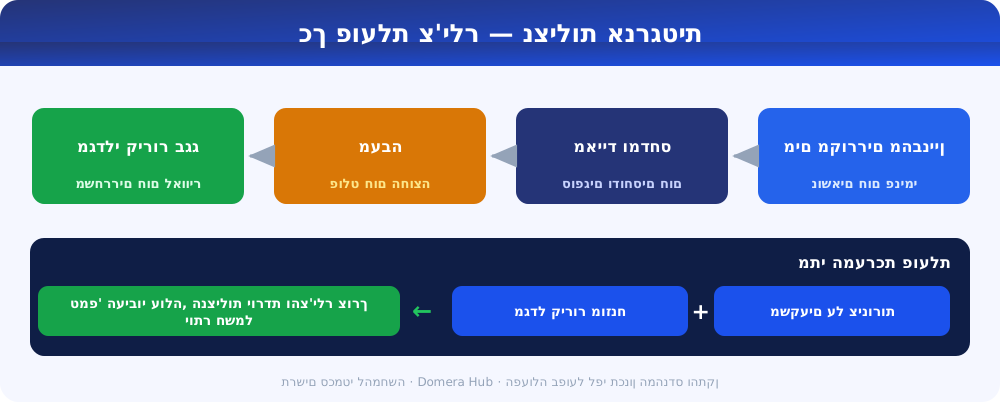
The chiller operates on a thermodynamic cooling cycle (a vapor-compression cycle) exactly like a home refrigerator — only on the scale of hundreds of tons of cooling. Four core components make up the cycle: a compressor that compresses the refrigerant gas and raises its pressure and temperature; a condenser in which the hot gas expels its heat outward and turns to liquid; an expansion valve that lowers the pressure; and an evaporator in which the cold liquid absorbs heat from the building's chilled water and evaporates. Thus, in a cyclical sequence, heat is "pumped" out of the building and expelled outside.
In terms of water flows there are two separate loops: the chilled-water loop (about 6-7°C) that leaves the evaporator toward the terminal units on the floors and returns "warmer" water to the chiller; and the condenser-water loop that carries the heat expelled from the condenser to the cooling towers on the roof, where the heat is released to the air. In other words, the chiller transfers heat from inside the building to the cooling towers — and so the two systems always work in a pair.
Two common chiller types are distinguished by how they expel heat: water-cooled — more energy efficient, expels heat through cooling towers, common in large buildings; and air-cooled — expels heat directly to the air via fans, simpler but less efficient. Energy efficiency is measured in ratios such as COP (Coefficient of Performance) or kW/RT (kilowatts of electricity per ton of cooling): the better the ratio, the less electricity the chiller consumes for the same amount of cooling. The chiller is the core of the central air-conditioning system, and any drop in its efficiency rolls straight onto the electricity bill.
Why the System Is Needed + Risks of Neglect
The chiller is needed because it provides the cooling for the entire building — and without it, in an Israeli summer, an office or commercial building is simply unusable. But beyond availability, its critical value is energetic and economic: because the chiller is the largest electricity consumer, a few percent drop in efficiency translates into thousands and even tens of thousands of shekels a year in wasted electricity.
The risks of neglecting the chiller accumulate on several planes:
- Energetic-economic — a neglected chiller loses efficiency gradually and quietly: deposits on the condenser/evaporator tubes (fouling), a shortage of refrigerant, a worn compressor — all raise electricity consumption for the same cooling, sometimes by 10%-30% and more. This is "quiet waste" that continues for months without a complaint from the occupants.
- Legal and regulatory — large chillers (over 100 tons of cooling) are subject to a statutory energy-efficiency test on behalf of the Ministry of Energy; failing to perform it is non-compliance with a legal requirement.
- Operational-mechanical — neglect leads to compressor failure, refrigerant leaks, lubrication problems, and corrosion — faults that cost a fortune to repair and shut down the cooling at the height of summer, when a technician is hardest to obtain.
- Environmental (ESG) — an inefficient chiller = more electricity = a larger carbon footprint, which harms the property's energy management and ESG targets.
The Maintenance Regime — What, How Often, and How
The chiller system has two separate maintenance planes that are important not to confuse: the mechanical-routine maintenance on one hand, and the regulatory energy-efficiency test on the other. The test fixed in our requirements matrix is the energy one:
- Energy-efficiency test — three-yearly (every 36 months). Applies to chillers with an output over 100 tons of cooling, and it is a statutory legal requirement. In the test, the chiller's efficiency ratio (the cooling delivered relative to the electricity consumed) is measured in practice and compared to the required performance, in order to identify erosion, operational problems, or the potential for energy savings.
- The document to keep: the energy-efficiency test report — the official output of the test, signed by the authorized party.
Beyond the three-yearly regulatory test, the chiller requires ongoing mechanical maintenance throughout the year to preserve its efficiency and prevent failure — cleaning the condenser/evaporator tubes, checking the level and quality of the refrigerant, monitoring pressures and temperatures, lubrication, and servicing the compressor. The ongoing maintenance regime is carried out by the chiller's service company per the manufacturer's guidance; for details on the mechanical maintenance of the air-conditioning system, see the HVAC maintenance guide. In our facts block, the fixed frequency is that of the efficiency test only — and so the ongoing maintenance frequency is set by the manufacturer's guidance and the service contract, and we do not fix a figure here.
Who Is Authorized to Maintain and Certify
The energy-efficiency test and its certification are performed solely by an energy-efficiency examiner authorized by the Ministry of Energy — a professional specifically certified to measure and assess the chiller's performance, holding the required measuring equipment. This is the party that issues the energy-efficiency test report, which is the document determining compliance with the legal requirement.
An important distinction: the authorized examiner is not necessarily the same party that performs the ongoing mechanical maintenance. The ongoing maintenance is usually performed by a service company authorized by the chiller manufacturer or a skilled refrigeration technician; whereas the regulatory efficiency test — only by an energy-efficiency examiner authorized by the Ministry of Energy. Do not rely on a maintenance service report as a substitute for the official efficiency report — they are two different documents with different purposes.
Standards and Regulation
The energy-efficiency test of chillers over 100 tons of cooling is a legal (statutory) requirement in the energy domain, under the responsibility of the Ministry of Energy, and its frequency is once every three years. The party performing and certifying it is an energy-efficiency examiner authorized by the Ministry of Energy, and the binding output is the energy-efficiency test report.
An important clarification: in our requirements matrix the test is defined as three-yearly, statutory, for chillers over 100 tons, by an examiner authorized by the Ministry of Energy, with an energy-efficiency test report as the binding document — but it contains no SI standard number or specific clause cited for the chiller. Therefore we do not cite a particular standard number here, and refer generally to the standard and the current guidelines of the Ministry of Energy and the manufacturer. The exact threshold, measurement method, and requirements are determined by the authorized examiner according to the regulation in force.
Required Documentation and Forms
The document that holds the chiller's compliance with the regulatory requirement is the energy-efficiency test report — the output of the three-yearly test signed by the authorized examiner. Manage it as a live file with an expiry date, since the test is renewed once every three years.
The chiller has no dedicated fire form (unlike fire-suppression systems, many of which have a uniform form from the national fire and rescue authority) — the binding documentation in the efficiency context is the energy-efficiency test report issued by the Ministry of Energy examiner. Alongside this, keep the ongoing maintenance reports from the service company (cleaning, refrigerant, compressor servicing) as documentation of the service history. To an inspector or an energy audit — the valid efficiency report is the proof that the chiller was tested and complies with the requirement.
Common Faults and Warning Signs
- A quiet rise in electricity consumption — the most important sign of an efficiency drop: the chiller still cools, but consumes more electricity for the same output. Detected by monitoring consumption against cooling, not by an occupant's complaint.
- Deposits and fouling on the condenser/evaporator tubes — a layer of scale or biofilm reduces heat transfer and raises consumption; directly related to the water quality of the cooling towers.
- A shortage or leak of refrigerant — impairs the cooling capacity and the efficiency; requires leak detection and topping up by an authorized technician.
- Abnormal noise/vibration in the compressor or out-of-range pressures/temperatures — signs of mechanical wear that may lead to a costly compressor failure.
- Neglected cooling towers — a dirty cooling tower or one with poor-quality water raises the condensing temperature and lowers the chiller's efficiency; the two systems are interdependent (and also a Legionella risk focus).
- "An expired or missing efficiency report" — the common documentation fault: the chiller over 100 tons is operating, but there is no valid efficiency test report — and in terms of the law this is non-compliance.
The Value of Professional Maintenance Management / How Domera Helps
The chiller illustrates well the gap between "working" and "working correctly": a system can cool excellently and simultaneously waste tens of percent of electricity, and a regulatory test once every three years is very easy to miss. Domera's Knowledge Hub is designed to help the building manager see these costly and quiet components before they turn into waste or non-compliance.
In practice, in the Domera system the efficiency test is managed through a preventive maintenance program (PPM): for the test, one open instance exists at any given moment, and closing it requires attaching the certifying energy-efficiency test report. The system sends a reminder before expiry — so that the three-yearly test is renewed on time and not at the last minute — and produces compliance reports showing exactly whether the report is valid. In parallel, orderly management of the ongoing service reports makes it possible to identify an efficiency-erosion trend early, and to fix it before the bill jumps.
Frequently Asked Questions
What is a chiller and why is it important?
A chiller is the building's central cooling machine — it cools water and circulates it to the air-conditioning system to cool all the floors. It is especially important because it is usually the largest energy consumer in the building, and so its efficiency directly affects the electricity bill and the property's carbon footprint.
What is an energy-efficiency test for a chiller?
It is a test that measures in practice the chiller's efficiency ratio — how much cooling it delivers for each kilowatt of electricity it consumes — and compares it to the required performance. Its purpose is to identify erosion, operational problems, and the potential for energy savings. In Israel it is a legal requirement for large chillers.
How often must an energy-efficiency test be performed?
The energy-efficiency test is three-yearly — once every three years (36 months) — for chillers with an output over 100 tons of cooling, and is performed by an energy-efficiency examiner authorized by the Ministry of Energy. At its end an energy-efficiency test report is issued that must be kept valid.
When does the efficiency-test obligation apply (100 tons)?
The regulatory obligation for the energy-efficiency test applies to chillers with an output over 100 tons of cooling. Chillers smaller than this threshold are not subject to this statutory test, but still require ongoing mechanical maintenance to preserve performance.
Who is authorized to perform and certify the efficiency test?
Only an energy-efficiency examiner authorized by the Ministry of Energy is authorized to perform the test and issue the energy-efficiency test report. This is not necessarily the same party that performs the ongoing mechanical maintenance, which is carried out by a service company on behalf of the chiller manufacturer.
What is the connection between the chiller and the cooling towers?
In a water-cooled chiller, the heat pumped from the building is expelled through the condenser-water loop to the cooling towers on the roof, where it is released to the air. Therefore the two systems work in a pair: a neglected cooling tower raises the condensing temperature and lowers the chiller's efficiency — and it is also a Legionella risk focus.
What happens if the efficiency test is not performed?
For a chiller over 100 tons, the absence of a valid energy-efficiency test report is non-compliance with a legal requirement on behalf of the Ministry of Energy. Beyond the law — a chiller whose efficiency has eroded without a test may quietly waste tens of percent of electricity over years.
How does Domera help manage the chiller?
Through a preventive maintenance program (PPM): one open instance for the efficiency test, closing against the certifying energy-efficiency test report, a reminder before expiry to renew the three-yearly test on time, and compliance reports — alongside management of the ongoing maintenance reports for early identification of efficiency erosion.
Further Reading
- The PPM guide — how to build a complete preventive maintenance program for the building, across all systems and forms.
- Chiller and cooling-tower maintenance — the ongoing mechanical maintenance of the central air-conditioning system and the cooling towers.
- Air-conditioning system maintenance — the broad picture of the air-conditioning system, the terminal units, and ongoing operation.
- The energy audit guide — managing energy consumption, auditing, and reporting, to which the chiller contributes the largest part.
- Water, backflow preventer, and Legionella — the cooling towers, water quality, and Legionella risk related to the chiller's condenser loop.
- The Knowledge Hub — all the guides on building systems in one place.
Frequently asked questions
What is a chiller and why is it important?
A chiller is the building's central cooling machine — it cools water and circulates it to the air-conditioning system to cool all the floors. It is especially important because it is usually the largest energy consumer in the building, and so its efficiency directly affects the electricity bill and the property's carbon footprint.
What is an energy-efficiency test for a chiller?
It is a test that measures in practice the chiller's efficiency ratio — how much cooling it delivers for each kilowatt of electricity it consumes — and compares it to the required performance. Its purpose is to identify erosion, operational problems, and the potential for energy savings. In Israel it is a legal requirement for large chillers.
How often must an energy-efficiency test be performed?
The energy-efficiency test is three-yearly — once every three years (36 months) — for chillers with an output over 100 tons of cooling, and is performed by an energy-efficiency examiner authorized by the Ministry of Energy. At its end an energy-efficiency test report is issued that must be kept valid.
When does the efficiency-test obligation apply (100 tons)?
The regulatory obligation for the energy-efficiency test applies to chillers with an output over 100 tons of cooling. Chillers smaller than this threshold are not subject to this statutory test, but still require ongoing mechanical maintenance to preserve performance.
Who is authorized to perform and certify the efficiency test?
Only an energy-efficiency examiner authorized by the Ministry of Energy is authorized to perform the test and issue the energy-efficiency test report. This is not necessarily the same party that performs the ongoing mechanical maintenance, which is carried out by a service company on behalf of the chiller manufacturer.
What is the connection between the chiller and the cooling towers?
In a water-cooled chiller, the heat pumped from the building is expelled through the condenser-water loop to the cooling towers on the roof, where it is released to the air. Therefore the two systems work in a pair: a neglected cooling tower raises the condensing temperature and lowers the chiller's efficiency — and it is also a Legionella risk focus.
What happens if the efficiency test is not performed?
For a chiller over 100 tons, the absence of a valid energy-efficiency test report is non-compliance with a legal requirement on behalf of the Ministry of Energy. Beyond the law — a chiller whose efficiency has eroded without a test may quietly waste tens of percent of electricity over years.
How does Domera help manage the chiller?
Through a preventive maintenance program (PPM): one open instance for the efficiency test, closing against the certifying energy-efficiency test report, a reminder before expiry to renew the three-yearly test on time, and compliance reports — alongside management of the ongoing maintenance reports for early identification of efficiency erosion.