
In this article
- How the System Works
- Why It Is Needed and the Risks of Neglect
- The Maintenance Regime (What / How Often)
- Who Is Authorized to Maintain and Certify
- Standards and Regulation
- Documentation and Forms
- Common Faults and Warning Signs
- The Value of Professional Maintenance Management / How Domera Helps
- Frequently Asked Questions
- Further Reading
- Frequently asked questions
Pre-Action System — A Dry Sprinkler System for Sensitive Spaces
A pre-action system is a variant of an automatic sprinkler system in which the piping is not filled with water but with air or pressurized gas, and water enters it only after an independent fire-detection event. In practical terms: the system protects exactly like ordinary sprinklers, but prevents accidental water discharge — which is why it is the preferred system in server rooms, archives and freezer storage, where an accidental flood is more costly than the fire itself.
For a building manager or maintenance engineer, the difference between a pre-action system and an ordinary "wet" system is not merely engineering — it is operational and regulatory. There are two components here that require licensed maintenance in two separate disciplines, and a lapse in either one may leave the sensitive space unprotected at exactly the critical moment. In this article we will explain how the system works, why it is used, what maintenance regime is required in Israel, and how to manage all of this without falling between the cracks.
Part of a bigger picture: the pre-action system is one component within a complete preventive-maintenance program. For the full framework — all the systems, frequencies, licensed parties and forms — see the complete PPM guide.
How the System Works
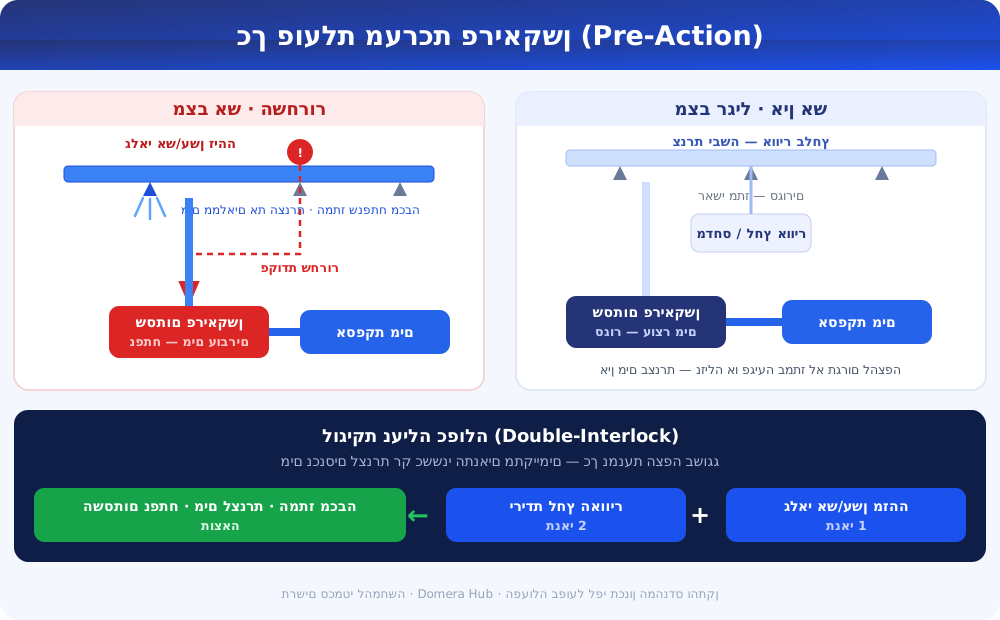
At its core, a pre-action system is a dry-pipe sprinkler system: the piping above the heads normally contains no water but air or nitrogen at low pressure, known as "supervisory pressure." The water waits behind a main valve — the pre-action valve — until a command is received to open it.
What makes the system unique is its release logic. In an ordinary wet system, the moment a sprinkler head bursts from heat, water is discharged immediately. In a pre-action system an additional, independent condition is required: an independent fire-detection system (smoke or heat detectors) must identify a fire and issue a command to open the pre-action valve. Only then does water fill the piping.
In the configuration common to the most sensitive spaces — Double-Interlock — two independent events are required to release water: (1) fire detection by the detection system, and also (2) a drop in air pressure in the piping (which indicates that a sprinkler head has in fact opened or broken). Thus, if a pipe is accidentally damaged or a head is broken during work — an alarm is raised, but water will not be released as long as there is no genuine fire event as well. This is deliberate protection against accidental flooding, a "safety delay" that is the whole idea of the system.
In terms of water supply, the pre-action system is part of the building's overall fire-suppression array: it relies on a fire pump and on a fire-suppression reservoir to supply water at the moment of opening, and on the detection system to open the valve. The supervisory pressure in the piping is maintained by an air receiver (pressure vessel) — a component we will discuss later, because it carries its own separate inspection requirement.
Why It Is Needed and the Risks of Neglect
The value of a pre-action system is clear anywhere that accidental flooding is unacceptable — because water damage may be more severe and costly than the damage from the fire itself. Typical environments:
- Server rooms and data centers — water dripping onto live electrical equipment = immediate damage, data loss and downtime.
- Archives, libraries and museums — documents, books and collectors' items that cannot be restored after getting wet.
- Cold storage and freezers — in a wet system the water in the piping would freeze and burst; a dry system solves this fundamentally.
The risk of neglect is twofold, and hence the importance of maintenance. First, a system that is not maintained may fail to open when needed — the result is a sensitive space that burns without protection. Second, and this is unique to pre-action, a fault in the air pressure or in the release logic may cause the system to "leak" water without a genuine fire event — that is, exactly the damage for which this expensive and complex system was chosen in the first place. Neglecting the pressure vessel / air receiver is even more dangerous: this is a pressure vessel, and a pressure-vessel failure is a safety risk in its own right.
The Maintenance Regime (What / How Often)
A pre-action system has two separate inspection tracks, and both are a legal requirement:
- Pre-action system inspection — annual (every 12 months). The inspection is performed by an authorized maintenance company holding a standards mark, and includes a functional check of the pre-action valve, the supervisory pressures, the link to the detection system, and water flow under a controlled opening. The document to keep: an inspection certificate from the maintenance company.
- Air receiver / pressure vessel inspection of the pre-action system. The pressure vessel that supplies the supervisory air is a pressure vessel, and therefore must be inspected separately by a licensed air-receiver inspector. The document to keep: an inspection report. This is a completely separate discipline from the annual system inspection — do not assume the maintenance company covers it as well.
This distinction between the two tracks is the point where it is easiest to slip: a building manager who documents only the annual certificate from the maintenance company, but not the air-receiver inspection report, is in practice non-compliant, even if "there is a certificate in the binder."
Who Is Authorized to Maintain and Certify
The authorizations are divided by the component being inspected, and this is essential:
- The system itself — inspected and maintained solely by an authorized maintenance company holding a standards mark for the field of fire-suppression systems. Such a company is required to be familiar with the guidelines of the standard and of the National Fire and Rescue Authority.
- The pressure vessel / air receiver — inspected by a licensed air-receiver inspector, holding dedicated certification for inspecting pressure vessels of this type. This is not a role for the fire-suppression company but for a pressure-vessel inspector.
In short: one certificate is not enough. A complete pre-action setup requires two documents from two different licensed professionals — the annual certificate from the maintenance company, and the air-receiver inspection report from the licensed inspector.
Standards and Regulation
Inspection of the pre-action system is a legal (statutory) requirement, and so is the air-receiver inspection. Operating and maintaining the system are subject to the standard and the guidelines of the National Fire and Rescue Authority. It is important to be precise: there is no dedicated fire form and unique Israeli Standard number that is explicitly directed at the pre-action system within our requirements matrix — and therefore we will not cite here a specific "SI" (Israeli Standard) for pre-action, but will refer generally to the standard and the Authority's guidelines.
The closest regulatory context is the direct "sibling" of pre-action — the automatic sprinkler system, whose compliance certificate is Fire Form 7 under SI 1596. Pre-action is, in engineering terms, a sprinkler variant, and therefore the compliance principles of the sprinkler system are the most relevant comparison. However — since the specific legal requirement for pre-action is defined, as noted, by the standard, the Authority's guidelines and the maintenance company's inspection, and not by Form 7 itself — do not rely on Form 7 as a substitute for the annual pre-action certificate.
Documentation and Forms
Two documents uphold pre-action compliance, and both must be kept and valid:
- Inspection certificate from the maintenance company — the output of the annual system inspection.
- Inspection report for the air receiver / pressure vessel — the output of the inspection by the licensed air-receiver inspector.
Manage the two documents as two live files, each with an expiration date. From the perspective of a regulator or an investigator in the event of an incident, the two documents are the proof that the system is maintained and sound. It is important to note the expiration dates of each one separately, because they are set by different parties and on different dates.
Common Faults and Warning Signs
- Loss of air pressure / recurring pressure alarms — an air leak in the piping or a fault in the air receiver; may cause a false opening or an inability to open.
- Detection system disconnected or faulty — in a pre-action system, without detection there is no valve opening. A disabled detector = a system that will not operate in a real fire.
- Pre-action valve not functionally tested — a valve "stuck" closed will not admit water; a valve that opens accidentally = flooding.
- Air receiver with an expired report / without a report — an un-inspected pressure vessel is both a safety risk and non-compliance.
- "There is a certificate but no report" — one of the most common documentation faults: the annual inspection is documented and the air receiver is forgotten.
The Value of Professional Maintenance Management / How Domera Helps
A pre-action system is a perfect example of what is hard to manage manually: two inspection tracks, two professionals, two documents, two expiration dates — and every miss leaves a sensitive space either without protection or without compliance. Domera's Knowledge Hub is designed precisely to help the building manager see this picture clearly.
In practice, in the Domera system the pre-action is managed through a preventive-maintenance program (PPM): each inspection opens one instance that is open at any given moment, and closing it requires attaching the certifying document (the maintenance company's certificate or the air-receiver inspection report). The system sends reminders before expiration — separately for each of the two tracks — and produces compliance reports that show exactly what is valid and what is overdue. The idea is simple: not to rely on memory, but on a system that closes the loop against the document.
Frequently Asked Questions
What is the difference between a pre-action system and a wet sprinkler system?
In a wet system the piping is normally full of water, and water is discharged immediately when a sprinkler head opens. In a pre-action system the piping is full of pressurized air, and water enters only after an independent fire-detection event — thus preventing accidental water discharge.
Why invest in the more expensive pre-action system at all?
In spaces where accidental flooding causes severe damage — server rooms, archives, museums and freezer storage — the damage from accidental water may exceed the damage from the fire. Pre-action adds a deliberate layer of protection against unjustified water discharge.
How often must the pre-action system be inspected?
The annual system inspection is performed once every 12 months by an authorized maintenance company holding a standards mark. In addition, the pressure vessel (air receiver) is inspected separately by a licensed air-receiver inspector. Both inspections are a legal requirement.
Who is authorized to inspect and certify the system?
The system itself is inspected and certified by an authorized maintenance company holding a standards mark. The pressure vessel / air receiver is inspected by a licensed air-receiver inspector — holding separate certification for pressure vessels. These are two different professionals.
Which documents must be kept?
Two documents: an inspection certificate from the maintenance company (from the annual system inspection), and an inspection report for the air receiver / pressure vessel (from the licensed inspector). Both must be valid in order to meet legal requirements.
What is the air receiver / pressure vessel and why is it inspected separately?
This is the component that holds the supervisory air under pressure in the piping. Since it is a pressure vessel, the law requires it to be inspected by a licensed air-receiver inspector, separately from the annual inspection of the suppression system — an un-inspected pressure vessel is a safety risk in its own right.
Does Form 7 (SI 1596) apply to pre-action?
Fire Form 7 under SI 1596 refers to the automatic sprinkler system — the wet "sibling" of pre-action. It is the closest standards context, but it is not a substitute for the annual pre-action certificate; the legal requirement for pre-action is defined by the standard, the Authority's guidelines and the maintenance company's inspection.
How does Domera help manage this?
Through a preventive-maintenance program (PPM): one open instance per inspection, closing against the certifying document, separate reminders before expiration for each of the two tracks, and compliance reports that show exactly what is valid and what is overdue.
Further Reading
- The PPM Guide — how to build a complete preventive-maintenance program for a building.
- Sprinkler system compliance certificate (Form 7) — the wet "sibling" of pre-action and standard SI 1596.
- Knowledge Hub — all the guides on building systems in one place.
- Sprinkler and fire-suppression system maintenance — the wet sibling of pre-action, inspection and maintenance.
- Fire and smoke detection system maintenance — the system that issues the release command to pre-action.
- Managing a server room in a building — cooling, power and fire suppression in the most sensitive space.
- Backflow prevention, Legionella and the fire reservoir — maintenance of the water and the reservoir that feeds the suppression system.
- Form 4 — fire detection system maintenance certificate — the Authority's uniform form for fire detection.
- Fire systems in an office building — inspections, responsibility and what a building manager sees in the field.
Frequently asked questions
What is the difference between a pre-action system and a wet sprinkler system?
In a wet system the piping is normally full of water, and water is discharged immediately when a sprinkler head opens. In a pre-action system the piping is full of pressurized air, and water enters only after an independent fire-detection event — thus preventing accidental water discharge.
Why invest in the more expensive pre-action system at all?
In spaces where accidental flooding causes severe damage — server rooms, archives, museums and freezer storage — the damage from accidental water may exceed the damage from the fire. Pre-action adds a deliberate layer of protection against unjustified water discharge.
How often must the pre-action system be inspected?
The annual system inspection is performed once every 12 months by an authorized maintenance company holding a standards mark. In addition, the pressure vessel (air receiver) is inspected separately by a licensed air-receiver inspector. Both inspections are a legal requirement.
Who is authorized to inspect and certify the system?
The system itself is inspected and certified by an authorized maintenance company holding a standards mark. The pressure vessel / air receiver is inspected by a licensed air-receiver inspector — holding separate certification for pressure vessels. These are two different professionals.
Which documents must be kept?
Two documents: an inspection certificate from the maintenance company (from the annual system inspection), and an inspection report for the air receiver / pressure vessel (from the licensed inspector). Both must be valid in order to meet legal requirements.
What is the air receiver / pressure vessel and why is it inspected separately?
This is the component that holds the supervisory air under pressure in the piping. Since it is a pressure vessel, the law requires it to be inspected by a licensed air-receiver inspector, separately from the annual inspection of the suppression system — an un-inspected pressure vessel is a safety risk in its own right.
Does Form 7 (SI 1596) apply to pre-action?
Fire Form 7 under SI 1596 refers to the automatic sprinkler system — the wet "sibling" of pre-action. It is the closest standards context, but it is not a substitute for the annual pre-action certificate; the legal requirement for pre-action is defined by the standard, the Authority's guidelines and the maintenance company's inspection.
How does Domera help manage this?
Through a preventive-maintenance program (PPM): one open instance per inspection, closing against the certifying document, separate reminders before expiration for each of the two tracks, and compliance reports that show exactly what is valid and what is overdue.