
In this article
- How the System Works
- Why the System Is Needed + Risks of Neglect
- The Maintenance Regime — What, How Often, and How
- Who Is Licensed to Maintain and Certify
- Standards and Regulation
- Required Documentation and Forms
- Common Faults and Warning Signs
- The Value of Professional Maintenance Management / How Domera Helps
- Frequently Asked Questions
- Further Reading
- Frequently asked questions
Kitchen-Hood Fire Suppression & Duct Cleaning — A Maintenance & Compliance Guide
A kitchen-hood fire-suppression system is a dedicated fire-suppression system installed above the cooking points, which automatically extinguishes a grease fire (Class K fire) using a wet-chemical extinguishing agent. Alongside it, periodic cleaning of the hood ducts is required, since the layer of grease that accumulates in the ducts is the most dangerous fuel in a commercial kitchen — and therefore both actions are a legal requirement and are handled as two separate tracks.
For a building manager running a commercial center, a mall, an office tower with catering kitchens, or a restaurant — this is one of the hottest risk points, literally. A grease fire ignites quickly, behaves differently from an ordinary fire, and spreads through the ducts into the roof void and air passages. This article explains how the system works, why the two tracks — suppression and cleaning — are inseparable, what the maintenance regime is in Israel, who is licensed, and which standards and forms must be kept valid.
Part of a bigger picture: the hood suppression system and duct cleaning are one component within a complete preventive-maintenance program. For the full framework — all the systems, frequencies, licensed parties and forms — see the complete PPM guide.
How the System Works
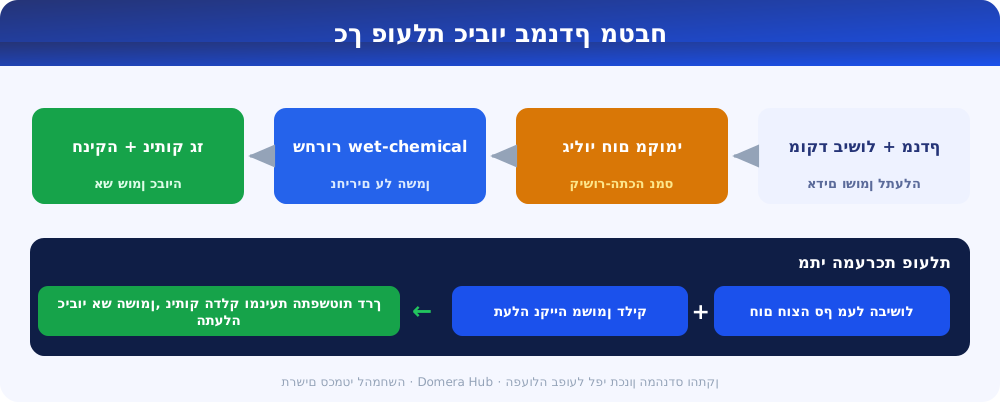
The system is built from three parts that work as a whole. First, the hood above the cooking point collects the vapors, grease and heat and channels them into an exhaust duct that leads outside. Second, the wet-chemical suppression system: a tank of wet-chemical extinguishing agent is connected to a network of nozzles located inside the hood, above each cooking appliance (fryer, grill, cooktop) and inside the duct opening itself.
Activation is based on local heat detection: when the temperature above the cooking point crosses a threshold — a fusible link melts or a heat sensor activates the system, and then the wet extinguishing agent is released through the nozzles directly onto the cooking surface and inside the duct. The third and critical part: shutting off the fuel/gas supply — activation includes automatically closing off the gas or electricity supply to the cooking point, in order to cut off the heat source.
What makes wet-chemical suppression the right choice here is the nature of a grease fire (Class K fire): burning cooking oil does not react like an ordinary fire, and water in fact would cause it to erupt violently. The wet-chemical agent forms a foaming soap layer (saponification) over the oil surface that smothers the fire and cools the surface, preventing re-ignition. This is why an ordinary sprinkler system should not be used here — the suppression is tailored specifically to the type of fire.
Why duct cleaning is an inseparable part of the system: all the cooking vapors flowing through the duct leave behind a layer of flammable grease that keeps accumulating. A grease-fouled duct becomes a fire-spread pathway: if a fire breaks out in the kitchen, the grease in the duct ignites and carries the fire into the roof void and hidden spaces that are very hard to extinguish. Therefore duct cleaning is not a side "technical maintenance" task but a central safety component — a perfect suppression system above a fouled duct still leaves a severe fire risk.
Why the System Is Needed + Risks of Neglect
A commercial kitchen concentrates all three elements of the fire triangle in one place: sustained high heat, a large quantity of flammable oil, and an oxygen-rich airflow through the hood. A grease fire is one of the most dangerous scenarios in a commercial building, and it erupts and spreads quickly.
The risk of neglect is twofold, exactly along the two tracks:
- An unmaintained suppression system — nozzles blocked with grease, fusible links not checked, a tank at incorrect pressure, or a fuel shut-off that does not work. The result: when a grease fire breaks out, the system does not respond or responds partially, and the fire spreads uncontrolled.
- A grease-fouled duct — even if the suppression above the cooking point worked, the grease layer in the duct supplies fuel for fire spread through the roof void. A neglected duct is the common reason a "small" kitchen fire becomes a building fire.
Beyond the threat to life and property damage — since both tracks are a legal (statutory) requirement, the absence of a valid certificate means non-compliance with the business licensing and the fire-service requirements, and can jeopardize insurance coverage in the event of an incident. In a commercial kitchen, this is not neglect that can be "pushed to next quarter."
The Maintenance Regime — What, How Often, and How
The system has two separate inspection tracks, both at a semi-annual frequency (every 6 months) and both a legal requirement, applying to every site:
- Inspection of the kitchen-hood suppression system — semi-annual (every 6 months). The inspection includes examining the extinguishing-agent tank and its pressure, the integrity of the nozzles and their being free of grease blockage, the fusible links / heat sensors, and the fuel/gas shut-off mechanism. The document to keep: Fire and Rescue Services form number 9 A / B.
- Cleaning of the kitchen-hood ducts — semi-annual (every 6 months). Thorough cleaning of the grease that has accumulated along the exhaust ducts, in order to remove the flammable fuel from the spread pathway. The document to keep: Fire and Rescue Services form number 16.
Note that these are two separate maintenance events, even if they are scheduled for the same date. A manager who documents only the suppression-system inspection but not the duct cleaning is in fact in non-compliance, even if "the system was inspected." The actual cleaning frequency depends on the cooking load: a kitchen busy with frying may require more frequent cleaning than the basic semi-annual frequency — here one should rely on the manufacturer's and the authority's guidance and on inspecting the actual condition of the grease.
Who Is Licensed to Maintain and Certify
Both tracks are carried out by an authorized maintenance company holding a standard mark for the field of fire-suppression systems. Such a company is required to be familiar with the standard's guidance and with the requirements of the National Fire and Rescue Authority, and to be qualified both for inspecting the suppression system (form 9 A/B) and for documenting the duct cleaning (form 16).
The practical meaning: a general "duct cleaner" without certification will not suffice, and certainly not an in-house maintenance worker, for a statutory certificate. The binding certificate comes from an authorized company holding a standard mark, which can sign the authority's standard forms.
Standards and Regulation
Both tracks are a legal (statutory) requirement, and each has a dedicated Israeli standard and a standard fire-service form:
- The hood suppression system — per SI 5356 Part 2, and the compliance certificate is fire-service form 9 (A/B) — a compliance certificate for a hood fire-suppression system. (SI 5356 Part 1 also deals with hood suppression systems; the binding reference in our requirements matrix is to Part 2.)
- Duct cleaning — per SI 1001 Part 6, and the execution certificate is fire-service form 16 — a hood-cleaning certificate.
The regulatory context is fire safety in catering businesses and business licensing, under the National Fire and Rescue Authority. Any detail not explicitly stated here should be applied per the current standard and the authority/manufacturer guidance, without inventing a clause number or a frequency.
Required Documentation and Forms
Two documents hold the system's compliance, and both must be kept and be valid:
- Fire and Rescue Services form number 9 A / B — a compliance certificate for the hood suppression system, per SI 5356 Part 2.
- Fire and Rescue Services form number 16 — a certificate for cleaning the hoods and ducts, per SI 1001 Part 6.
Manage both forms as two living files, each with an expiry date. In the event of a fire-service audit, an incident investigation or a business-license renewal — the two forms together are the proof that the kitchen is protected and sound. It is important to track the expiry of each one separately, even if they are performed in parallel.
Common Faults and Warning Signs
- Nozzles blocked with grease — grease buildup on the nozzle openings prevents an even dispersal of the extinguishing agent; a sign that cleaning is neglected or that the inspection was not performed.
- Low pressure in the extinguishing-agent tank — a pressure gauge outside the correct range indicates a system that will not release a sufficient quantity of agent.
- The fuel/gas shut-off mechanism not tested — if the gas is not closed automatically on activation, the heat source remains active and the fire may re-ignite.
- A thick grease layer in the duct — can be identified by touch or by visual inspection at the access openings; indicates a need for immediate cleaning, even before the scheduled cleaning date.
- "We inspected the system but did not clean the ducts" — a common documentation fault: form 9 is documented while form 16 is forgotten, leaving partial non-compliance.
- Fusible links covered with vapor/grease — may impair the detection sensitivity and the system's response time.
The Value of Professional Maintenance Management / How Domera Helps
Hood suppression is a clear example of a system that is easy to let "fall through the cracks" in management: two separate semi-annual inspections, two forms, two standards, and two expiry dates — and every miss leaves the kitchen at fire risk or in non-compliance. Domera's Knowledge Hub is designed to help the building manager see this picture clearly.
In practice, in Domera the system is managed through a preventive-maintenance program (PPM): for each inspection — both the suppression and the cleaning — a single open instance is opened at any given moment, and closing it requires attaching the certifying form (form 9 A/B or form 16). The system sends reminders before expiry, separately for each of the two tracks, and produces compliance reports that show exactly what is valid and what is overdue. The idea is simple: don't rely on memory, but on a system that closes the loop against the document.
Frequently Asked Questions
Why use wet-chemical suppression rather than water or a sprinkler in a kitchen hood?
A grease fire (Class K fire) erupts violently on contact with water. A wet-chemical agent forms a foaming soap layer over the oil surface that smothers the fire and cools the surface, preventing re-ignition — which is why it is the suppression suited to this type of fire.
How often should the hood suppression system be inspected?
Inspection of the hood suppression system is performed once every 6 months (semi-annual) by an authorized maintenance company holding a standard mark, and it is a legal requirement. The document kept is fire-service form 9 A/B.
How often are the hood ducts cleaned?
Duct cleaning is a legal requirement at a semi-annual frequency (every 6 months), documented in fire-service form 16. In kitchens with a high frying load, more frequent cleaning may be required, per the manufacturer's and the authority's guidance and the actual condition of the grease.
Why is duct cleaning considered part of the suppression system and not just cleaning?
The grease layer that accumulates in the duct is a flammable fuel that turns the duct into a fire-spread pathway to the roof void. Even a sound suppression system above a fouled duct leaves a severe fire risk — so cleaning is a central safety component, not a side maintenance task.
Who is licensed to inspect and certify?
Both tracks — the suppression-system inspection and the duct cleaning — are carried out by an authorized maintenance company holding a standard mark, qualified to sign the standard forms of the National Fire and Rescue Authority. An in-house maintenance worker or a general cleaner is not a substitute for the statutory certificate.
Which standards and forms apply to the system?
The hood suppression system is certified with fire-service form 9 (A/B) per SI 5356 Part 2; duct cleaning is certified with fire-service form 16 per SI 1001 Part 6. Both forms must be kept valid.
What happens if one of the two certificates is missing?
Both tracks are a legal requirement, so the absence of either — the suppression inspection or the duct cleaning — means non-compliance. This can jeopardize the business license and insurance coverage in the event of an incident, even if the other track is sound.
How does Domera help manage this?
Through a preventive-maintenance program (PPM): a single open instance per inspection, closure against the certifying form (9 A/B or 16), separate reminders before expiry for each of the two tracks, and compliance reports that show exactly what is valid and what is overdue.
Further Reading
- The complete PPM guide — how to build a complete preventive-maintenance program for a building, with all the systems and frequencies.
- Sprinkler and fire-suppression system maintenance — the building's overall suppression system, of which the hood is a special case.
- The Knowledge Hub — all the guides on building systems in one place.
Frequently asked questions
Why use wet-chemical suppression rather than water or a sprinkler in a kitchen hood?
A grease fire (Class K fire) erupts violently on contact with water. A wet-chemical agent forms a foaming soap layer over the oil surface that smothers the fire and cools the surface, preventing re-ignition — which is why it is the suppression suited to this type of fire.
How often should the hood suppression system be inspected?
Inspection of the hood suppression system is performed once every 6 months (semi-annual) by an authorized maintenance company holding a standard mark, and it is a legal requirement. The document kept is fire-service form 9 A/B.
How often are the hood ducts cleaned?
Duct cleaning is a legal requirement at a semi-annual frequency (every 6 months), documented in fire-service form 16. In kitchens with a high frying load, more frequent cleaning may be required, per the manufacturer's and the authority's guidance and the actual condition of the grease.
Why is duct cleaning considered part of the suppression system and not just cleaning?
The grease layer that accumulates in the duct is a flammable fuel that turns the duct into a fire-spread pathway to the roof void. Even a sound suppression system above a fouled duct leaves a severe fire risk — so cleaning is a central safety component, not a side maintenance task.
Who is licensed to inspect and certify?
Both tracks — the suppression-system inspection and the duct cleaning — are carried out by an authorized maintenance company holding a standard mark, qualified to sign the standard forms of the National Fire and Rescue Authority. An in-house maintenance worker or a general cleaner is not a substitute for the statutory certificate.
Which standards and forms apply to the system?
The hood suppression system is certified with fire-service form 9 (A/B) per SI 5356 Part 2; duct cleaning is certified with fire-service form 16 per SI 1001 Part 6. Both forms must be kept valid.
What happens if one of the two certificates is missing?
Both tracks are a legal requirement, so the absence of either — the suppression inspection or the duct cleaning — means non-compliance. This can jeopardize the business license and insurance coverage in the event of an incident, even if the other track is sound.
How does Domera help manage this?
Through a preventive-maintenance program (PPM): a single open instance per inspection, closure against the certifying form (9 A/B or 16), separate reminders before expiry for each of the two tracks, and compliance reports that show exactly what is valid and what is overdue.