
In this article
- How the system works
- Why the system is needed + risks of neglect
- The maintenance regime — what, how often, and how
- Who is authorized to maintain and certify
- Standards and regulation
- Documentation and required forms
- Common faults and warning signs
- The value of professional maintenance management / How Domera helps
- Frequently asked questions
- Further reading
- Frequently asked questions
Fire Pump — The Heart of the Building's Firefighting Network
A fire pump is the pump that supplies pressure and water flow to the building's firefighting network — to the sprinklers, the hose reels and the firefighting stations — the moment that municipal water pressure is insufficient to extinguish a fire on every floor and in every corner. In simple terms: it is the component that turns a static water reservoir into an active firefighting network at the correct pressure, and without it even the most expensive firefighting systems may simply fail to reach their target at the moment of truth.
For a building manager or maintenance engineer, the fire pump is a critical junction: it is not "just another piece of equipment in the pump room" but the component on which every other firefighting system depends. A silent fault in the pump — one no one noticed because it almost never runs — effectively neutralizes the sprinklers and firefighting stations even if they themselves are perfectly sound. In this article we explain how the pump works, why it is needed, the maintenance regime required in Israel, who is authorized to inspect it, and how to manage all of this without relying on memory.
Part of a bigger picture: the fire pump is one component within a complete preventive maintenance plan. For the full framework — all the systems, frequencies, authorized parties and forms — see the complete PPM guide.
How the system works
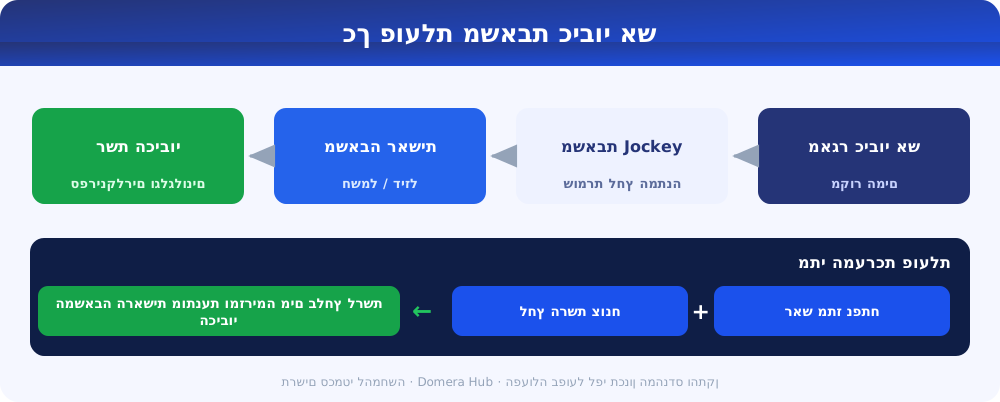
At its core, the fire pump system is built from three parts that work together: the water source, the standby pump (Jockey Pump) and the main pump. The water source is usually a dedicated fire water reservoir, whose role is to ensure a volume of water is available even if the city supply weakens or is cut off during a fire.
The Jockey Pump is a small pump that runs occasionally just to maintain constant standby pressure in the network. Its job is to prevent the main pump from starting for tiny leaks or marginal pressure drops — so the large pump is not started needlessly and is not worn out. As long as network pressure is high, the main pump stays quiet.
The main pump comes into action at the moment of truth: when a sprinkler head opens or a firefighting station is used, network pressure drops below a defined threshold, and this automatically starts the main pump, which delivers water at high pressure and flow to the network. The main pump can be electric (driven by an electric motor) or diesel (driven by a diesel engine). In many buildings a diesel pump is chosen precisely because it does not depend on the electricity supply — which may be cut off exactly at the time of a fire — and therefore continues to operate even during a power outage. A diesel pump, of course, depends on sound diesel fuel in its tank.
From here it is clear why the pump is a central junction: it feeds pressure to the sprinkler system, to the hose reels and firefighting stations, and sometimes additional firefighting systems. All of these are sound "on paper", but without pressure from the pump they may fail to spray water at the required effectiveness.
Why the system is needed + risks of neglect
The need for a fire pump stems from a simple physical gap: municipal water pressure is designed for everyday use, not for extinguishing a fire on high floors and at multiple points simultaneously. The taller the building and the more points must be supplied with water at once, the greater the pressure and flow required that the city alone cannot provide. The pump closes exactly this gap.
The risk of neglect is especially severe because the pump almost never needs to operate — and that is precisely the trap. Equipment that runs daily reveals faults immediately; a fire pump can sit idle for months and appear sound, while in reality a closed valve, an engine that will not start, a drained battery or contaminated diesel will prevent it from operating at the moment of truth. The result: a fire in which the sprinklers are "open" but there is not enough pressure and water to extinguish it — that is, a failure of the entire firefighting chain at once.
Alongside the safety risk come legal and insurance aspects. Inspection of the fire pump is a legal requirement, and a failure to perform it may be considered non-compliance with the National Fire and Rescue Authority. In the event of an incident, the absence of valid inspection certificates may also impair insurance coverage — since the insurer expects proof that the system was maintained as required.
The maintenance regime — what, how often, and how
The fire pump has one main inspection track, and diesel pumps add a further unique track:
- Fire pump inspection — annual (every 12 months). The inspection is carried out by a licensed maintenance company holding a standard mark. It includes a controlled operation of the pump, testing of automatic start-up on pressure drop, testing of pressure and flow, and testing of the adjacent components (valves, pressure gauge, activation mechanism). The document to keep: an inspection certificate by the maintenance company. This is a legal (statutory) requirement, applying to every site where a fire pump is installed.
- Diesel quality test for a diesel pump — annual (every 12 months). In pumps driven by a diesel engine, the fuel in the tank ages, water accumulates in it and biological contamination may develop — and then the engine will not start when needed. Therefore a diesel quality test is required once a year, carried out by an accredited laboratory. The document to keep: an analysis report from an accredited laboratory. This test is not marked as a legal requirement in our matrix but as a recommended practice — yet it is critical to the pump's actual availability.
Beyond these two periodic inspections, it is common practice in the field to perform periodic pump run-ups (churn / spill test) according to the manufacturer's guidance and the standard — to verify that the engine starts, that the pump reaches pressure, and that the batteries and fuel are in good condition. Our matrix has no specific mandatory frequency for these run-ups beyond the annual inspection, so one should act according to the manufacturer's guidance and the standard — and not rely on the official annual inspection alone.
Who is authorized to maintain and certify
Authorizations are divided by what is being inspected:
- The pump itself — inspected and maintained solely by a licensed maintenance company holding a standard mark for the field of fire suppression systems. Such a company is required to be familiar with the standard's guidelines and the requirements of the National Fire and Rescue Authority, and it is the one that issues the annual inspection certificate.
- Diesel quality (for a diesel pump) — inspected by a laboratory accredited by the Israel Laboratory Accreditation Authority, which issues an analysis report. This is a separate discipline from inspecting the pump itself — do not assume the maintenance company also covers the diesel test.
The practical point: in a building with a diesel pump, one certificate is usually not enough. Both the maintenance company's inspection certificate and the laboratory's diesel analysis report are required — two documents from two different parties.
Standards and regulation
Inspection of the fire pump is a legal (statutory) requirement applying to every site where such a pump is installed. The pump's operation, performance and maintenance are subject to the standard and the guidelines of the National Fire and Rescue Authority and the manufacturer. It is important to be precise: our requirements matrix contains no dedicated Israeli Standard (SI) number or fire form number explicitly directed at the fire pump itself — so we will not cite a specific "SI" for the pump here, but instead refer generally to the standard and the guidelines of the Authority and the manufacturer.
The closest standards context is the system the pump feeds — the automatic sprinkler system, whose compliance certificate is Fire Form 7 under SI 1596. Since the pump is an inseparable part of the water supply array for the sprinklers, its performance is examined as part of the overall compliance of the firefighting network — but the pump's own annual inspection certificate, issued by the maintenance company, is the direct document attesting to its soundness.
Documentation and required forms
The documents that hold up the fire pump's compliance:
- Inspection certificate by the maintenance company — the output of the pump's annual inspection. This is the central document.
- Analysis report from an accredited laboratory — in a building with a diesel pump, this is the output of the annual diesel quality test.
The fire pump itself has no uniform dedicated fire form in the matrix — but since it feeds the sprinklers, it is worth managing its documentation together with the sprinkler compliance certificate (Form 7, SI 1596), which is the closest regulatory form in the firefighting array. Manage each certificate as a live file with an expiry date, so that at any moment it is clear what is valid and when it must be renewed.
Common faults and warning signs
- Main valve closed or half-closed — one of the most dangerous faults: a valve left closed after work leaves the pump disconnected from the network with no external sign.
- The main pump does not start during inspection — a failure in the engine, the start-up or the pressure-drop detection mechanism; meaning that at the moment of truth no pressure will be supplied.
- Jockey Pump running non-stop — a sign of a constant leak in the network or a pressure fault; it wears out the small pump and masks a real problem.
- Drained battery in a diesel pump — a diesel engine depends on the battery to start; a weak battery = a pump that will not operate during a power outage, exactly when it is most needed.
- Contaminated / old / water-laden diesel — causes failure to start or engine shutdown during operation; the reason an annual diesel quality test is so important.
- Low standby pressure on the gauge — an early sign of a system fault; requires immediate inspection before it becomes a failure.
The value of professional maintenance management / How Domera helps
The fire pump is a clear example of a component that is hard to manage manually: it almost never runs, it has a mandatory annual inspection, a diesel pump adds an annual diesel test from another party, and a fault in it is invisible until the moment of truth. Every miss leaves the entire firefighting network exposed. Domera's Knowledge Center is designed to help the building manager see this picture clearly.
In practice, in the Domera system the fire pump is managed through a preventive maintenance plan (PPM): for each inspection one open instance exists at any given time, and closing it requires attaching the confirming document (the maintenance company's certificate, and for a diesel pump also the diesel analysis report). The system sends reminders before expiry — separately for each track — and produces compliance reports that show exactly what is valid and what is overdue. The idea is simple: don't rely on the fact that "the pump was installed once", but on a system that closes the loop against the document.
Frequently asked questions
Why does a building even need a fire pump?
Municipal water pressure is designed for everyday use and is not sufficient to extinguish a fire on high floors and at several points simultaneously. The fire pump adds pressure and flow so that the sprinklers and hose reels deliver water at the required effectiveness at the moment of truth.
What is the difference between a diesel pump and an electric pump?
An electric pump is driven by an electric motor, and a diesel pump by a diesel engine. The advantage of diesel is independence from the electricity supply — it continues to operate even during a power outage, which may occur during a fire. In return, a diesel pump also requires engine, battery and sound-fuel maintenance.
What is the Jockey Pump and why is it needed?
The Jockey Pump is a small pump that maintains constant standby pressure in the network and covers tiny leaks, so the main pump is not started needlessly for marginal pressure drops. If it runs non-stop, this is a sign of a leak or a pressure fault that requires inspection.
How often is the fire pump inspected?
The pump inspection is carried out once a year (every 12 months) by a licensed maintenance company holding a standard mark, and it is a legal requirement. For a diesel pump an annual diesel quality test by an accredited laboratory is added. Beyond that, it is recommended to perform periodic run-ups according to the manufacturer's guidance and the standard.
Who is authorized to inspect and certify the pump?
The pump itself is inspected and certified by a licensed maintenance company holding a standard mark, which issues the inspection certificate. The diesel quality (in a diesel pump) is inspected by a laboratory accredited by the Israel Laboratory Accreditation Authority, which issues an analysis report. These are two different parties.
Why is the diesel quality tested at all?
Diesel in the tank of a diesel pump ages, water accumulates in it and biological contamination may develop — all of which prevent the engine from starting or cause it to shut down during operation. An annual diesel quality test verifies that the pump will indeed work the moment it is required.
What happens if the pump is not maintained?
A neglected pump may fail to supply pressure and water during a fire, thereby effectively neutralizing the entire firefighting network — the sprinklers and hose reels — even if they themselves are sound. This is also accompanied by a risk of non-compliance with the National Fire and Rescue Authority and possible impairment of insurance coverage.
How does Domera help manage this?
Through a preventive maintenance plan (PPM): one open instance per inspection, closing against the confirming document, separate reminders before expiry for each track, and compliance reports that show exactly what is valid and what is overdue.
Further reading
- The PPM guide — how to build a complete preventive maintenance plan for a building.
- Fire detection and suppression system maintenance — the building's firefighting systems that the fire pump integrates with, inspection and maintenance.
- Extinguishers, hose reels and firefighting stations — the firefighting equipment that also depends on pressure from the pump.
- Sprinkler system compliance certificate (Form 7) — the fire form of the sprinkler network under SI 1596.
- Knowledge Center — all the guides on building systems in one place.
Frequently asked questions
Why does a building even need a fire pump?
Municipal water pressure is designed for everyday use and is not sufficient to extinguish a fire on high floors and at several points simultaneously. The fire pump adds pressure and flow so that the sprinklers and hose reels deliver water at the required effectiveness at the moment of truth.
What is the difference between a diesel pump and an electric pump?
An electric pump is driven by an electric motor, and a diesel pump by a diesel engine. The advantage of diesel is independence from the electricity supply — it continues to operate even during a power outage, which may occur during a fire. In return, a diesel pump also requires engine, battery and sound-fuel maintenance.
What is the Jockey Pump and why is it needed?
The Jockey Pump is a small pump that maintains constant standby pressure in the network and covers tiny leaks, so the main pump is not started needlessly for marginal pressure drops. If it runs non-stop, this is a sign of a leak or a pressure fault that requires inspection.
How often is the fire pump inspected?
The pump inspection is carried out once a year (every 12 months) by a licensed maintenance company holding a standard mark, and it is a legal requirement. For a diesel pump an annual diesel quality test by an accredited laboratory is added. Beyond that, it is recommended to perform periodic run-ups according to the manufacturer's guidance and the standard.
Who is authorized to inspect and certify the pump?
The pump itself is inspected and certified by a licensed maintenance company holding a standard mark, which issues the inspection certificate. The diesel quality (in a diesel pump) is inspected by a laboratory accredited by the Israel Laboratory Accreditation Authority, which issues an analysis report. These are two different parties.
Why is the diesel quality tested at all?
Diesel in the tank of a diesel pump ages, water accumulates in it and biological contamination may develop — all of which prevent the engine from starting or cause it to shut down during operation. An annual diesel quality test verifies that the pump will indeed work the moment it is required.
What happens if the pump is not maintained?
A neglected pump may fail to supply pressure and water during a fire, thereby effectively neutralizing the entire firefighting network — the sprinklers and hose reels — even if they themselves are sound. This is also accompanied by a risk of non-compliance with the National Fire and Rescue Authority and possible impairment of insurance coverage.
How does Domera help manage this?
Through a preventive maintenance plan (PPM): one open instance per inspection, closing against the confirming document, separate reminders before expiry for each track, and compliance reports that show exactly what is valid and what is overdue.