In this article
- How the system works
- Why the system is needed + risks of neglect
- The maintenance regime — what, how often, and how
- Who is qualified to maintain and certify
- Standards and regulation
- Required documentation and forms
- Common faults and warning signs
- The value of professional maintenance management / how Domera helps
- Frequently asked questions
- Further reading
- Frequently asked questions
Emergency Generator — Maintenance, Testing and Compliance Guide
An emergency generator is a power generator (usually diesel) that starts automatically when the building's electrical grid fails, and feeds the critical systems — elevators, emergency lighting, fire pumps, fire detection and computing systems — until power returns. It matters because in a modern building a power outage is not merely an inconvenience: it can strand an elevator with passengers inside, shut down a fire suppression system, or bring down a server room — which is why the law in Israel requires the generator to be inspected and certified periodically.
For a building manager or maintenance engineer, the emergency generator is one of the most "silent" systems — unused most of the time — and precisely for that reason the most dangerous to neglect: the failure only reveals itself at the moment of emergency, when it is already too late. In this article we explain how the system works, what the automatic transfer switch (ATS) is, why a full-load test differs from a routine run, what maintenance regime is required in Israel, who is qualified to certify, and what Form 8 is.
Part of a bigger picture: the emergency generator is one component in a complete preventive maintenance plan. For the full framework — all the systems, frequencies, qualified professionals and forms — see the full PPM guide.
How the system works
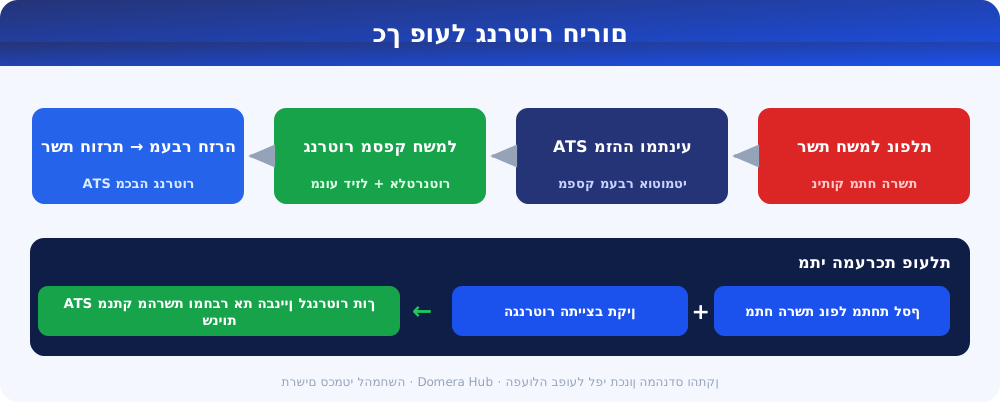
At its core, the emergency generator consists of a diesel engine driving an alternator (generator) that produces electricity. Around it are support systems: a diesel fuel tank (day tank + reservoir), a cooling system, starting batteries, and a control panel. But the component that turns the generator from a "machine" into an "automatic emergency system" is the automatic transfer switch (ATS).
The flow of operation is simple in principle: the ATS continuously monitors the electric utility's grid. The moment it detects a voltage failure, it issues a start command to the generator. Within seconds the engine stabilizes, and the ATS disconnects the building from the grid and connects it to the generator — so that the generator's power does not "flow" back into the disconnected grid (a dangerous condition called back-feed). When the grid returns and stabilizes, the ATS performs the reverse move: it returns the building to the grid and shuts the generator down after cooldown.
An essential point that a maintenance manager must understand: there is a difference between a no-load run — a routine start in which the generator simply "warms up" without supplying real power to the building — and a full-load test, in which the generator is forced to supply the full required output and is checked that it holds it. A generator that is started every week without a load can appear "sound" and still collapse at the moment of emergency when the full output is demanded of it. Therefore, as we will see shortly, the full-load test is a separate, independently scheduled test.
The generator does not operate alone: it is part of the building's power continuity array. In critical systems, a server room is bridged by a UPS — which supplies continuous power from batteries during the seconds it takes the generator to come up — until the generator stabilizes and takes on the load. The sequence is: grid → failure → UPS bridges → generator comes up → grid returns. The generator is also tied to the fire suppression array: the critical electrical systems it feeds include pumps and emergency lighting, and diesel generators share with fire pumps the issue of diesel fuel quality.
Why the system is needed + risks of neglect
The need for an emergency generator arises from the fact that in a tall or systems-heavy building, some systems must operate even — and perhaps especially — during a power outage: elevators (so passengers are not trapped), emergency lighting and exit signage (for safe evacuation), fire pumps, and detection systems. In a prolonged grid outage, a generator is the difference between a functioning building and a paralyzed one.
The risk of neglect is concentrated and cruel: the system fails silently, and reveals itself only in an emergency. A generator that has not been load-tested may start and collapse under a real load; drained starting batteries will not start it at all; old, contaminated diesel fuel, or fuel containing water/bacteria will clog filters and choke the engine; and an ATS fault means the generator will not engage automatically — or, worse, will feed power back into the grid and endanger the utility's workers. Beyond the safety risk, there is legal and insurance exposure: a valid generator certificate is a legal requirement, and its absence may harm insurance coverage and occupancy/business approvals.
The maintenance regime — what, how often, and how
The emergency generator has several parallel inspection tracks at different frequencies — and that is exactly what makes it prone to being missed. These are the inspections per the facts block:
- Generator service inspection — quarterly (every 3 months). Ongoing maintenance service (oil levels, cooling, batteries, filters) performed by a technician on behalf of a manufacturer-certified maintenance company. The document to keep: a service report. This is a recommended (non-statutory) service, but it is the foundation of the system's reliability.
- Full-load generator operation test — semi-annual (every 6 months). Performed by a suitably licensed electrician, and it checks that the generator actually holds the full required output — not just that it "starts." The document: a full-load generator operation certificate. This too is a recommended test, but it is the test that brings us closest to the real emergency scenario.
- Emergency generator soundness certificate — annual (every 12 months). Performed by a suitably licensed electrician, and it is a legal requirement (statutory). The document: Form 8 of the Fire and Rescue Services.
- Generator inspection by a testing electrician — annual for a building of 10 stories or more, and every 5 years for a building under 10 stories. Performed by a testing electrician holding a license matched to the connection size, and it is a legal requirement. The document: an electrical installation inspection certificate + Form 8.
- Diesel fuel quality test — annual. Performed by a laboratory accredited by the Israel Laboratory Accreditation Authority, and it detects aging, water and bacteria in the fuel. The document: an analysis report from an accredited laboratory. This test is shared by diesel generators and diesel fire pumps.
The logic behind the frequencies: the quarterly service keeps the machine fit; the semi-annual full-load operation verifies that it will truly hold up in an emergency; and the annual certificate (electrician + testing electrician) is the layer of legal compliance vis-à-vis the fire authority and the electrical installation. Do not assume that one covers the other — every line here is a separate action with its own qualified professional and its own document.
Who is qualified to maintain and certify
The qualifications are divided by type of inspection — and this is an essential point for legal compliance:
- Ongoing service maintenance — a technician on behalf of a maintenance company certified by the generator's manufacturer. This is the party that knows the specific model and supplies the quarterly report.
- Annual soundness certificate (Form 8) and full-load test — a suitably licensed electrician.
- Inspection of the generator as an electrical installation — a testing electrician holding a license matched to the building's connection size. Note: a "testing electrician" is a separate and higher qualification than a "certified electrician," and the license must match the electrical connection size.
- Diesel fuel quality test — a laboratory accredited by the Israel Laboratory Accreditation Authority, not the maintenance company.
In short: one certificate is not enough. A maintained and sound generator requires a combination of a service company (manufacturer), a licensed electrician, a testing electrician and a laboratory — each producing the document in its own domain.
Standards and regulation
The annual soundness certificate of the emergency generator and the testing electrician inspection are a legal requirement (statutory). The soundness certificate is documented on Form 8 of the Fire and Rescue Services ("Emergency generator soundness certificate"), and the testing electrician inspection is documented in an "electrical installation inspection certificate" accompanied by that same Form 8.
An important point of precision: in our requirements matrix, Form 8 does not carry a dedicated Israeli Standard (SI) number explicitly directed to it — so we will not cite a numeric "SI" here for the generator. The generator's maintenance and starting are subject to the current standard and the directives of the manufacturer and the National Fire and Rescue Authority, as well as to the electrical installation inspection requirements of a testing electrician. The main regulatory distinction is by building height: in a building of 10 stories or more the testing electrician inspection is annual, and in a lower building — every 5 years.
Required documentation and forms
The generator's compliance rests on several living documents, each with its own frequency and validity:
- Form 8 — Emergency generator soundness certificate (annual, licensed electrician). This is the central fire document. For a full breakdown of the form and what it includes, see the explanatory article: Emergency generator soundness certificate — Form 8.
- Electrical installation inspection certificate (from the testing electrician, attached to Form 8).
- Full-load generator operation certificate (semi-annual).
- Service report (quarterly, from the maintenance company).
- Diesel fuel analysis report (annual, from an accredited laboratory).
Manage each of these documents as a living file with its own independent validity date. From the standpoint of a regulator, an insurer or a post-incident investigator — the collection of documents is the proof that the generator is not merely "present" but genuinely maintained and sound.
Common faults and warning signs
- Drained or exhausted starting batteries — the most common cause of a generator that fails to start in an emergency. Sign: slow cranking or a start failure during a test.
- Aging diesel fuel / contaminated with water and bacteria — clogs filters and chokes the engine. Sign: abnormal smoke, drop in output, recurring filter clogging; detected in the diesel fuel analysis report.
- The generator "starts but does not supply" — appears sound in a no-load run, but collapses under a full load. Precisely why the full-load test is separate.
- ATS fault — the generator does not engage automatically, or does not disconnect from the grid (back-feed risk). Check the actual transfer operation, not just the generator.
- Low oil/cooling levels — mechanical failure under load; detected in the quarterly service.
- "There is a Form 8 but no fuel report / service report" — a common documentation fault: the annual certificate is recorded and the complementary tests are forgotten.
The value of professional maintenance management / how Domera helps
The emergency generator is a prime example of a system that is hard to manage manually: five inspection tracks at different frequencies (quarterly, semi-annual, annual, five-yearly), four types of professionals, and five documents with separate validity dates — and every miss leaves the building without backup power or out of compliance. Domera's Knowledge Center is meant to help the building manager see this picture clearly.
In practice, in the Domera system the generator is managed through a preventive maintenance (PPM) plan: for each inspection a single open instance is opened at any given moment, and closing it requires attaching the certifying document (Form 8, the service report, the fuel report or the load certificate). The system sends reminders before validity expires — separately for each track — and produces compliance reports that show exactly what is valid and what is out of compliance. The idea is simple: do not rely on the memory that a generator "was inspected once," but on a system that closes the loop against the document.
Frequently asked questions
How often must an emergency generator be inspected and run?
Per the facts block: quarterly service (every 3 months) by a maintenance company on behalf of the manufacturer; a semi-annual full-load operation test; an annual soundness certificate (Form 8) by a licensed electrician; and a testing electrician inspection — annual for a building of 10 stories or more, or every 5 years for a lower building. In addition, an annual diesel fuel quality test.
What is an ATS (automatic transfer switch)?
The ATS is the component that monitors the electrical grid, starts the generator automatically upon a voltage failure, transfers the building's load to it, and returns to the grid when it comes back — all without a human touch, and while preventing power from flowing back into the disconnected grid.
What is the difference between a routine run and a full-load test?
A no-load run only "warms up" the engine without supplying real power, so a generator can appear sound and still collapse in an emergency. A full-load test (semi-annual) forces the generator to supply the full output and verifies that it will truly hold up in a real scenario.
Who signs Form 8?
The annual soundness certificate on Form 8 of the Fire and Rescue Services is issued by a suitably licensed electrician. In parallel, a testing electrician holding a license matched to the connection size performs the electrical installation inspection of the generator (which is also attached to Form 8).
Why is the diesel fuel quality tested?
Diesel fuel ages, absorbs water and develops bacteria over time — which clogs filters and chokes the engine precisely when it is needed. An annual diesel fuel quality test, at a laboratory accredited by the Israel Laboratory Accreditation Authority, detects this in advance. The test is also shared with diesel fire pumps.
Does the emergency generator have a binding SI number?
In our requirements matrix, Form 8 (emergency generator soundness certificate) does not carry a dedicated SI number explicitly directed to it. The generator's maintenance is subject to the current standard and the directives of the manufacturer and the National Fire and Rescue Authority, and to the electrical installation inspection requirements.
Why does the generator inspection differ between a tall and a low building?
In a building of 10 stories or more, the testing electrician inspection of the generator is annual; in a building under 10 stories it is required every 5 years. The licensed electrician's soundness certificate (Form 8) remains annual in both cases.
What is the connection between the generator and the UPS?
The generator takes a few seconds to stabilize and supply power. In critical systems such as server rooms, a UPS bridges those seconds from battery backup, until the generator comes up and takes the load. The sequence: grid → UPS bridges → generator → back to the grid.
Further reading
- The PPM guide — how to build a complete preventive maintenance plan for the building, with all the frequencies and documents.
- Emergency generator soundness certificate — Form 8 — the fire authority's standard form for the generator: what it includes and who signs it.
- Generator maintenance in an office building — the field guide to the generator's ongoing maintenance.
- Electrical systems maintenance in an office building — the electrical installation, switchboards and inspections that the generator feeds and integrates with.
- Server room management in a building — power, cooling and continuity (UPS + generator) in the most critical space.
- Knowledge Center — all the guides on building systems in one place.
Frequently asked questions
How often must an emergency generator be inspected and run?
Per the facts block: quarterly service (every 3 months) by a maintenance company on behalf of the manufacturer; a semi-annual full-load operation test; an annual soundness certificate (Form 8) by a licensed electrician; and a testing electrician inspection — annual for a building of 10 stories or more, or every 5 years for a lower building. In addition, an annual diesel fuel quality test.
What is an ATS (automatic transfer switch)?
The ATS is the component that monitors the electrical grid, starts the generator automatically upon a voltage failure, transfers the building's load to it, and returns to the grid when it comes back — all without a human touch, and while preventing power from flowing back into the disconnected grid.
What is the difference between a routine run and a full-load test?
A no-load run only "warms up" the engine without supplying real power, so a generator can appear sound and still collapse in an emergency. A full-load test (semi-annual) forces the generator to supply the full output and verifies that it will truly hold up in a real scenario.
Who signs Form 8?
The annual soundness certificate on Form 8 of the Fire and Rescue Services is issued by a suitably licensed electrician. In parallel, a testing electrician holding a license matched to the connection size performs the electrical installation inspection of the generator (which is also attached to Form 8).
Why is the diesel fuel quality tested?
Diesel fuel ages, absorbs water and develops bacteria over time — which clogs filters and chokes the engine precisely when it is needed. An annual diesel fuel quality test, at a laboratory accredited by the Israel Laboratory Accreditation Authority, detects this in advance. The test is also shared with diesel fire pumps.
Does the emergency generator have a binding SI number?
In our requirements matrix, Form 8 (emergency generator soundness certificate) does not carry a dedicated SI number explicitly directed to it. The generator's maintenance is subject to the current standard and the directives of the manufacturer and the National Fire and Rescue Authority, and to the electrical installation inspection requirements.
Why does the generator inspection differ between a tall and a low building?
In a building of 10 stories or more, the testing electrician inspection of the generator is annual; in a building under 10 stories it is required every 5 years. The licensed electrician's soundness certificate (Form 8) remains annual in both cases.
What is the connection between the generator and the UPS?
The generator takes a few seconds to stabilize and supply power. In critical systems such as server rooms, a UPS bridges those seconds from battery backup, until the generator comes up and takes the load. The sequence: grid → UPS bridges → generator → back to the grid.