
In this article
- How the System Works
- Why the System Is Needed + Risks of Neglect
- The Maintenance Regime — What, How Often, and How
- Who Is Authorized to Maintain and Certify
- Standards and Regulation
- Required Documentation and Forms
- Common Faults and Warning Signs
- The Value of Professional Maintenance Management / How Domera Helps
- Frequently Asked Questions
- Further Reading
- Frequently asked questions
CO Detection System in Parking Garages
A CO detection system in parking garages is a detector network that identifies concentrations of carbon monoxide (CO) emitted by vehicle exhaust, and automatically activates the garage's ventilation fans to clear the gas before it reaches a dangerous level. Its importance stems from the fact that carbon monoxide is a colorless, odorless gas, toxic and even lethal at high concentration — and in a closed underground garage, where the air does not renew itself, this is the primary protection for drivers, pedestrians, and the maintenance team against poisoning.
Want to understand how the CO detector test fits into an orderly preventive maintenance program for the building? Read the complete PPM guide — the process, the matrix, and the testing frequencies for every system in the building.
How the System Works
The system is built from three main parts: CO detectors distributed across the garage area, a control panel, and ventilation fans (fresh-air fans and exhaust fans). The detectors continuously sample the carbon monoxide concentration in the air, usually by means of an electrochemical sensor, and report the reading to the panel. The panel compares the concentration against preset activation thresholds and decides when and at what intensity to activate the ventilation.
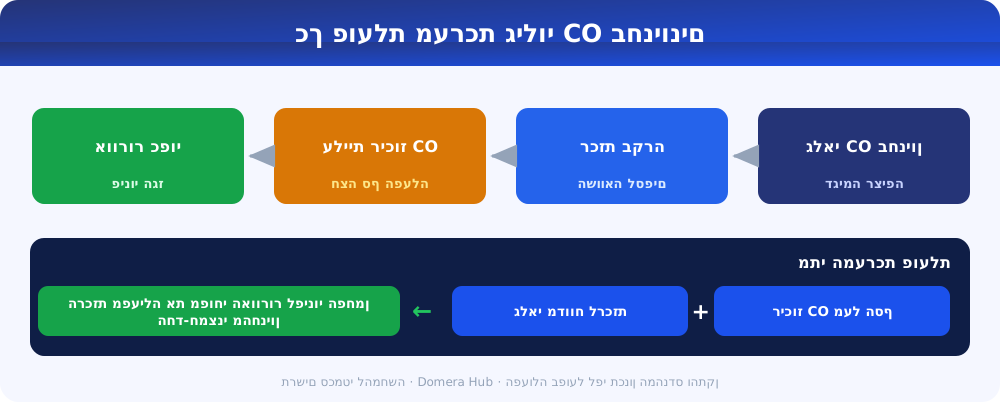
Activation is usually staged: when the concentration crosses a first threshold, the panel activates the ventilation fans to clear the gas; if the concentration continues to rise and crosses a higher threshold, the system switches to increased ventilation and sometimes sounds an audible or visual alert. When the concentration drops back to a safe range, the ventilation switches off or returns to basic operation — so that the system does not run the fans in needless continuity, but only when there is a real need for it, which also saves energy.
It is important to distinguish between a CO detection system and a fire and smoke detection system: the two look similar but their purpose is entirely different. Fire detection identifies smoke and flame and alerts for evacuation; CO detection identifies a transparent toxic gas and activates ventilation. These are two separate systems, with different detectors, thresholds, and maintenance parties.
Why the System Is Needed + Risks of Neglect
An underground or closed garage is an environment with no natural air exchange. Vehicles being started, moving, and idling emit carbon monoxide that accumulates quickly, and without active ventilation the concentration can reach a dangerous level within minutes. Because the gas is colorless and odorless, no one senses it until the poisoning symptoms appear — headache, nausea, dizziness, and in severe cases loss of consciousness and death. The CO detection system is the one that identifies the danger in time and activates the ventilation even before a risk to a person is created.
Neglecting the system is especially dangerous because it is "quiet": a detector that has aged, lost calibration, or become clogged with dust will continue to appear functional but will report a lower concentration than the truth — meaning the ventilation will not be activated in time, and no one will know about it until disaster strikes. The reverse scenario, of an erroneous upward report, will cause needless running of the fans and a waste of energy. Beyond the safety risk, testing the system is a legal requirement: the absence of a valid functional certificate exposes the building to a deficiency in inspection, to possible impairment of the insurance coverage in the event of damage, and to personal exposure of the building manager and the property owners.
The Maintenance Regime — What, How Often, and How
According to the preventive maintenance matrix, the test of the "garage CO detection system" is performed at an annual (once-a-year) frequency, and it applies to every site where such a system is installed. The test usually includes verifying the integrity of all the detectors on the list of installed detectors, examining the calibration and response of the sensors, checking that the activation thresholds actually activate the ventilation fans, and verifying the communication between the detectors and the panel. CO detectors based on an electrochemical sensor wear out over the years, and so an important part of the test is verifying that no detector has exceeded its service life and replacing detectors that have expired.
Because the value of the system is realized only when the ventilation actually works, the annual test also relies on the integrity of the garage's air-conditioning and ventilation systems. Air-conditioning and ventilation system maintenance — cleaning fans, checking motors and dampers — is what ensures that when the panel gives an activation command, the air is actually exchanged. The exact frequencies for all the building's systems can be seen in the matrix in the PPM guide.
Who Is Authorized to Maintain and Certify
The testing and certification of a CO detection system are performed by a company authorized for maintenance by the equipment manufacturer. A self-check by the maintenance team or a general technician should not suffice: this is dedicated detection equipment whose calibration and maintenance require a party explicitly authorized by the manufacturer of the installed system, per the manufacturer's guidelines and the current standard and authority guidance. The authorized party is the one who signs the functional certificate attached to the building file.
Standards and Regulation
The CO detection system test is defined as a legal (statutory) requirement and applies to every site where such a system is installed. The system's design, the detector locations, the activation thresholds, and the required ventilation rate are set per the current standard and the guidance of the authority and the manufacturer for closed garages; do not rely on a standard number or threshold value that does not appear explicitly in the system documentation and the manufacturer's certification. It is important to remember that the standards for CO detection are separate from those for fire detection — each system is subject to its own requirements.
Required Documentation and Forms
The binding document for the building file is a testing and functional certificate for the CO detectors, including a list of all the detectors that were tested, issued by the authorized company at each annual test. The list of detectors is especially important: it is what makes it possible to verify that every detector in the garage was actually tested and not just some of them, and to track detectors that were replaced or expired. A CO detection system has no dedicated form from the fire services as other suppression systems do, and so the authorized company's certificate and the list of detectors are the central documentation that must be kept and presented at inspection.
Common Faults and Warning Signs
From the field, these are the signs the maintenance team should watch for between tests:
- An expired detector — the electrochemical CO sensor wears out over time; after the service life defined by the manufacturer the detector must be replaced, even if it appears functional.
- Ventilation fans that do not switch on — if the test reveals that the activation thresholds are crossed but the fans do not come on, the protection exists only on paper; the problem may be in the fan, the motor, or the link to the panel.
- A persistent exhaust smell or heavy air in the garage — a sign that the ventilation is insufficient or is not activated in time; requires immediate inspection.
- A fault light on the panel or a disconnected detector — a fault indication, a weak backup battery, or a disconnected detector nullify the protection without it being obvious to the eye.
- A detector covered with dust, dirt, or paint — impairs the sensor's ability to sample the air and distorts the reading downward.
- Recurring false alarms — may indicate an uncalibrated detector; they should not be silenced manually but rather have their cause investigated.
The Value of Professional Maintenance Management / How Domera Helps
A CO detection system is exactly the type of system that is easy to "forget": it is hidden in the garage ceiling, it has no prominent day-to-day indication, and its annual frequency comes only once a year — so the test date can easily pass without anyone noticing. This is where orderly maintenance management comes in. Domera manages a preventive maintenance program for each system with one open instance at any given moment, closes every test only against the certifying document (the functional certificate and the list of detectors), sends a reminder before the certificate expires, and centralizes a compliance report that shows at a glance which systems are valid and which require attention — so that the system meant to protect whoever is in the garage is genuinely ready for the moment of truth.
Frequently Asked Questions
What is a CO detection system and why is it important?
A CO detection system is a detector network that identifies concentrations of carbon monoxide in a parking garage and activates the ventilation fans to clear the gas. It is important because carbon monoxide is a toxic, colorless, odorless gas, and in a closed garage it can accumulate to a dangerous level without anyone sensing it — until poisoning symptoms appear.
How often is the CO detection system tested?
An annual test — once a year — by a company authorized for maintenance by the equipment manufacturer, per the preventive maintenance matrix.
Who is authorized to test and certify?
A company explicitly authorized for maintenance by the equipment manufacturer. The internal maintenance team or a general technician are not authorized to sign the functional certificate.
What is the difference between CO detection and fire detection?
They are two separate systems. Fire and smoke detection identifies smoke and flame and alerts for evacuation of the building; CO detection identifies transparent, odorless carbon monoxide gas and activates ventilation to clear the gas. Each has its own detectors, thresholds, and maintenance parties.
What happens when the detectors identify a high concentration?
The panel activates the ventilation fans to clear the gas, usually in a staged manner — basic ventilation at a first threshold and increased ventilation with an alert at a higher threshold. When the concentration drops to a safe range, the ventilation returns to normal operation.
What documentation should be kept in the building file?
A testing and functional certificate for the CO detectors including a list of all the detectors that were tested, issued at each annual test by the authorized company. The list of detectors makes it possible to verify that every detector was actually tested.
Is the test a legal requirement?
Yes. The test is defined as mandatory and applies to every site where a CO detection system is installed; the absence of a valid certificate exposes the building to a deficiency in inspection and to impairment of the insurance coverage.
Further Reading
- Managing a building's parking garage — the operation, safety, and ongoing maintenance of the garage in which the CO detection system is installed.
- Air-conditioning and ventilation system maintenance — the ventilation fans that the CO detection system activates, and the maintenance that ensures they will actually work.
- Fire detection and suppression system maintenance — the separate system for identifying fire and smoke, which must not be confused with CO detection.
- The complete PPM guide — the preventive maintenance process and the frequency matrix for all the building's systems.
- Domera's Knowledge Hub — all the guides and articles on building management and maintenance.
Frequently asked questions
What is a CO detection system and why is it important?
A CO detection system is a detector network that identifies concentrations of carbon monoxide in a parking garage and activates the ventilation fans to clear the gas. It is important because carbon monoxide is a toxic, colorless, odorless gas, and in a closed garage it can accumulate to a dangerous level without anyone sensing it — until poisoning symptoms appear.
How often is the CO detection system tested?
An annual test — once a year — by a company authorized for maintenance by the equipment manufacturer, per the preventive maintenance matrix.
Who is authorized to test and certify?
A company explicitly authorized for maintenance by the equipment manufacturer. The internal maintenance team or a general technician are not authorized to sign the functional certificate.
What is the difference between CO detection and fire detection?
They are two separate systems. Fire and smoke detection identifies smoke and flame and alerts for evacuation of the building; CO detection identifies transparent, odorless carbon monoxide gas and activates ventilation to clear the gas. Each has its own detectors, thresholds, and maintenance parties.
What happens when the detectors identify a high concentration?
The panel activates the ventilation fans to clear the gas, usually in a staged manner — basic ventilation at a first threshold and increased ventilation with an alert at a higher threshold. When the concentration drops to a safe range, the ventilation returns to normal operation.
What documentation should be kept in the building file?
A testing and functional certificate for the CO detectors including a list of all the detectors that were tested, issued at each annual test by the authorized company. The list of detectors makes it possible to verify that every detector was actually tested.
Is the test a legal requirement?
Yes. The test is defined as mandatory and applies to every site where a CO detection system is installed; the absence of a valid certificate exposes the building to a deficiency in inspection and to impairment of the insurance coverage.